Why do sprinters fall apart at the end of a race?


By Latif Thomas, Complete Track and Field

Recently, I had the distinct pleasure of attending a 6 hour freshman/sophomore meet. The meet was very well run, it was just, you know, a 6 hour freshman/sophomore meet. I can’t tell you how many times I watched sprinters fall apart at the end of races.
First of all, no. its not because of a lack of “conditioning”.
It is a coaching mistake to assume that, when sprinters get run down in races, the solution is more ‘conditioning’, whatever that means. And, yes, that applies to 400m training programs as well.
I didn’t invent these ideas. I learned them when I was preparing to teach the sprints and relays sections of the USTFCCCA Track & Field Technical Certification.
I thought it was a great way of thinking about how you should view your program design, or, perhaps more appropriately, view the ‘holes’ in your program design. After all, coaching high school sprinters is a wildly different animal than coaching in the collegiate environment.
Coaching success means starting with the end in mind. Without a clear understanding of how to design and implement an effective annual plan for sprinters, you’re doomed to making well intentioned, but false assumptions about why your sprinters fail to execute and perform.
So, again, there are only THREE reasons sprinters fall apart at the end of races.
As the coach, it is up to you to understand these reasons in order to consistently identify and fix the fatal technical flaws frustrating both you and your sprints squad. This article will help you figure out where and why things are going wrong, as well as how to fix the problem/s.

1. Energy System Failure
When coaches fail to adequately develop the anaerobic energy system, athletes often decelerate rapidly at the end of their race. This is frequently the cause in the 400, occasionally the cause in the 200 and never the cause in the 100.
In a nutshell, when coaches do too much aerobic and interval work and not enough acceleration (high intensity runs of 2-4 seconds), top end speed/maximum velocity (high intensity runs of 4-8 seconds), speed endurance (high intensity runs of 8-15 seconds), special endurance (high intensity runs of 20 seconds to 2 minutes), strength and power, (multi jumps, and multi throws) development, sprinters fail to develop the qualities required to be successful in the sprint events.
We can debate the split with 400 types. And, no doubt, you’ve watched your 400 runners tie up over the last 150 meters on multiple occasions. Your mind will tell you, “They need more ‘strength'”. If you do the math, you may find they simply don’t have the flat out speed to match top 400m specialists. Therefore, especially at the HS level, they don’t need more high volume, low intensity interval days. They need more work near, at or faster than race pace.
2. Coordination Erosion
After operating at top speeds for more than a few seconds, the body’s motor control systems tend to fail.
The ability to coordinate efficient movement patterns falls apart and then, if you know what you’re looking at, your sprinters are just stumbling and bumbling down the track, trying not to fall down. We see this most often toward the end of shorter sprint events.
If I were to break down the goals of my entire training philosophy and system, all into one sentence (after injury prevention) it would be:
Everything we do revolves around developing general and specific coordination.  Even our skipping is done in a very specific way:
Upright posture (chin up, chest up, toe up, knee up, heel up) and *flat* footed landing with the shin perpendicular to the ground at foot strike. If we let kids get away with toe or heel first landings, even during the warm up, it contributes to the insufficient motor patterns we’re working so hard to fix.
If coordination development isn’t a foundational part of your program, your sprinters probably get run down at the end of races, particularly against skilled sprinters with slightly less or equal levels of ability.
3. Momentum Deprivation
That’s a fancy term for having an ineffective ‘drive phase’. Your sprinters simply don’t push hard enough for long enough.
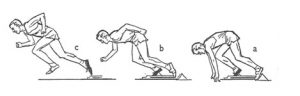
In truth, the problems start with their starting blocks settings. Most young sprinters are not properly situated in the blocks before the gun goes off.
Once the starting gun goes off, most inexperienced sprinters react like a sleeping cat when you slam two pans behind their head: Wild eyed, panicked and paying no particular attention to anything other than getting out of there as quickly as possible.
They might perform old school speed drills like Champions in practice. But when the gun goes off they immediately revert to whatever feels most natural.
Unfortunately, what feels natural is not fast. So they pick their head up, flick the drive arm up about 4 inches, step out of the blocks, stand straight up and start spinning their wheels like they’re auditioning to be the Road Runner. And we all know what happens to the Road Runner.
It’s sad really. Also, not fast.
So when they come out of blocks and shift gears too quickly or do some weird, seizure-like variation of the drive phase mechanics you were hoping for, it leads to not reaching their true top speed, getting to that fake top speed too early and beginning deceleration too soon.
In fact, you might consider holding your sprinters out of blocks until they show the ability to do quality down (3 point, 4 point) starts without blocks. Regardless of whether you adopt this approach, they still need to get set up properly in the down position if they’re going to develop any consistency, especially in the chaos of an actual race!
This is why we do some form of acceleration development every day. Yes, every day. Starting the first day of practice.
You just have to patient because unless you have naturally explosive and/or extremely strong athletes who can hack their way to fast 100m times day one, your kids will probably have to take a step back before taking two steps forward.
So, in summary, your athletes must possess the ability to express large amounts of strength and power for the duration of their race.
They need the general and specific coordination to execute a consistent, efficient and violent drive phase that transitions into consistent and efficient coordination of top end speed and speed maintenance mechanics.
And they need enough reps in practice at appropriate velocities and intensities to allow them to execute these skills in competitive situations.
The extent to which they develop these skills and qualities is directly proportional to how well you implement a training program addressing the workouts, volumes and intensities scientifically proven to generate faster times.


Improving the speed performance of a short distance athlete


Written by Amiskha Hattingh, Level III coach, VSAAV

There are several contradictions in the history of sprinting regarding the development and improvement of an athletes’ speed. This emphasise the believe that sprinters are born and not created (Douglas 2014). However, Seana (2016) argue that each athlete has a different type of muscle fiber compiled within their muscles. Athletes that have more fast-twitching muscles are more capable of sprinting, while athletes with more slow twitching muscles are better performers over longer distances. In addition, an athletes’ specific muscle type can be trained and regulated through specialised conditioning according to their muscle fibre. As such, fast-twitch fibers can be improved with sprints, weight preparation, and high intensity interval training, where long distance running will assist in developing slow-twitch muscles. Contrastingly, fast-twitch muscles also use less energy, given that it is more explosive, nevertheless, these muscles get tired quicker. Sauer (2018) state that genetic factors such as the size, body composition, mitochondria, and the fiber type of an athlete is heritable, and can therefore only be adapted and not changed.

Rautenbach (2019) further strengthen the fact that athletes can improve their speed performance through practising and developing accurate technique, physiological conditioning, strength training, as well as psychological preparation and planning. Therefore, the athlete that is the “quickest” does not automatically win the race. Contrastingly, the athlete who runs the furthest within the same time, while obtaining optimum speed have a higher chance of winning the race. This statement is supported with Usian Bolt’s world record of 9.58 seconds on the 100 meter sprint, where he kept his maximum speed for less than 20 meters.

Stander (2017) highlight several aspects that need to be taken into consideration to develop an athletes’ speed. This includes faster leg movement of the athlete, where leg speed can be improved, but according to a marginal tempo. Athletes’ stride length should be increased and maintained throughout the race. This technique requires a great deal of conditioning due to the fact that it is not a natural way of running. Therefore, the increasing of stride lengths improves the speed of an athlete dramatically. Speed can also be developed through sustaining top speed over a longer period of time. In addition, practise sessions that include speed endurance can also lead to improvement of an athletes’ sprinting time, but it is not recommended as a natural way of running. As such, strength and conditioning during several practise sessions is crucial to enable the athlete to efficiently complete these unnatural ways of running.

Another way to improve an athletes’ running speed is to focus on eccentric and isometric exercises. This implies that an athletes’ hamstring does not just act as knee flexors, but they also serve as a support system that keeps the knee joint stable while the force conveys from the hips. Therefore, strong hamstrings assist the glutes with hip extension and subsequently slows the knee extension down during the swing phase, which will ultimately lead to improved running speed. Furthermore, the effective use of an athletes’ arms serves as a vital factor to improve their running speed. It is recommended that athletes’ elbows are kept at 90 degrees, where each hand must be brought up in front of their face. In addition, the athletes body must not bend forward along with sagging shoulders, given that it will slow the athlete down (Sacks, 2015).

In order to increase an athletes speed performance, their explosive power needs to be trained and maintained effectively. Therefore, several repetitions of explosive movements must be practised to keep the athletes’ running form in shape. Different exercises can be done to develop an athletes’ speed; such as knee pick-ups where their knees are raised up until their waist within a short distance of 10 meters. The athletes’ main focus should be on their arms and elbows, where their elbows should be held at a 90-degree angle, as well as keeping their arms tension free. This exercise will also pressure the athlete to make as many ground contacts as they can.

Tuck jump exercises also assist athletes to develop speed. As such, athletes’ need to squat down, followed with straight high jumps. The athletes’ knees must be lifted up to their chest, where their landing must be shuttle and soft on their feet. Moreover, rocket jumps also improve the running speed of athletes. This exercise incorporates squatting, where the athlete explodes into the air with their body kept in a straight position and their arms stretched out above their head.

Skips can also increase an athletes’ sprinting speed. The athlete should try to lift their feet as high as possible through using their arms to assist their bodies on the high jumps. This exercise can be adapted, where athletes can skip over a specific distance. Therefore, athletes should attempt to skip as far as they can with each skip. This workout can be done over 30 meters (Stirner, 2019).

Again, Stander (2017) emphasise exercises that can be done in order to develop a good running technique, that will ultimately lead to the athletes’ development of speed. As such, athletes’ can practise high knees. Here the athlete jogs while they lift their knees high and move their feet downwards in a fast and straight position. The reach exercise can also be practised to generate speed. Therefore, the athlete must practise the exaggeration of each foreleg in a downfield position on the grass and not on the track.

Another method of developing speed within an athlete, is the running high on their toes exercise. Additionally, athletes must appear in a “tall” position, while they rise as high as possible on the ball of their feet. The athletes must then run on the definite spot that they are standing on, lean forwards from their heels, and then run down field staying high on the ball of their feet.

As such, the arm reach exercise can also be an effective approach to generate speed. The athlete must try and exaggerate their arm reach without attempting to run faster. The lead arm must be kept low while the athlete reaches forward. This technique will allow the athlete to run faster without any extra physical effort. Also, taking into consideration that the athletes’ hand and trail arm must not be lifted higher than their hips.

An alternative technique that can be incorporated is where the athlete must bound forward. This implies that athletes must bound forward and not upward, where they run down to the field in order for their head to maintain a straight position. The athlete must concentrate to always have one foot on their ground while they push against the ground with force. If the athlete jumps upwards, both their feet will be in the air, and it will be easy to assess any faults that the athlete makes.

In addition, athletes can incorporate the bounce exercise, where they have to lock their knees and bound forward through flipping their ankles. Athletes’ can also include the lean exercise within their training sessions. Here the athlete must stand with both of their feet together and lean forward from them heals which is about 30 degrees from a vertical angle. This lean must be sustained while the athlete strides downwards on the field.

In order to develop speed, athletes can make use of the run tall exercise. In addition, the athlete must put their hands against a wall, and back up as far as they can with their heels still on the ground. Thereafter, the athlete must rise on their toes while they lift their leading knee. It is crucial that the heel, hip and knee must stay in line at all given times.

Lastly, a relaxation exercise can be done in order to develop a good technique that will result in development of speed performance. The athlete must run with a total of 90 percent effort over 30 to 50 meters. Here the athlete must try to stay as relaxed as possible, while they run with an excessively loose jaw and relaxed hands. The emphasis is placed on the fact that the training of this technique must be free of effort.

Coultman (2018) identified several factors that sprinters should keep in mind when running, that will subsequently have an effect on the athletes’ speed performance. As such, athletes must try to keep their head in line with their spine, while they focus their eyesight directly down the track. The jaw and neck muscles of athletes should be relaxed at all times. Athletes’ should also stray from clenching on their teeth. In addition, athletes’ shoulders should not be raised up to their ear lopes, but rather be kept low and relaxed. Additionally, athletes should run with open palms, while their arms and legs correspond with each other. Athletes should also ensure that any extensions and flexing of their hip does not take place, due to the fact that it will limit the athletes’ range of motion. Another factor that is crucial in order to ensure an effective sprint, is that athletes should run on the ball of their feet and push forward with their toes. As such, athletes should maintain a long and comfortable stride, given that over striding of the legs will result in less power to use, and also stress and un-comfortability on the hamstrings of the athlete.

Genders (2016) also emphasise different types of running workouts in order to increase an athletes’ speed. Therefore, hills can be incorporated within training sessions, where it improves endurance with minimum muscle stress and elevate an effective running form. Another exercise that can be incorporated is fartleks. Fartleks are a Swedish word for speed play. This implies that the athlete will learn to run faster, combined with slower recovery jogs, and short rest intervals. Furthermore, interval training also assists athletes to run at a specific speed and a pre-set distance, as well as a specific recovery/rest period. This all depends on the fitness of the athlete. Because of the fact that an athletes sprinting form worsen approximately 75 percent into their race. As such, athletes need to be taught to maintain their sprint for 25 meters before the finish line. At this stage, athletes must develop a conditioned reflex, where they lift their knees higher, work harder with their arms, get on their toes into a tall running action, staying loose with their jaws and hands still relaxed, as well as focusing their eyes on the finish line, without looking around them.

To conclude, it is not natural for any athlete to run with high knees, on their toes, pushing explosively while running, or to work vigorously with their arms. Therefore, enough strength and conditioning is paramount within any sprinters workout. The abovementioned sprinting exercises must be done on a regular basis, in order for the athlete to adapt these exercises as a habit (Stander, 2017).

BIBLIOGRAPHY

Coultman, L. 2018. Sprinting technique: They key to increasing your speed. https://trackandfieldnews.com/track-coach/sprinting-technique-the-key-to-increasing-your-speed/ Date of access: 31 July 2019.

Douglas, S. 2014. Sprinters are born, not made. Runner’s world. https://www.runnersworld.com/races-places/a20794324/sprinters-are-born-not-made/ Date of access: 29 July 2019.

Genders, L. 2016. Types of running workouts to increase speed. https://www.leagendersfitness.com Date of access: 31 July 2019.

Rautenbach, S. 2019. Sprints, hurdles and relays. Basic coaching manual. Athletics.org.za. http://athletics.org.za/wp-content/uploads/2017/08/ASA-Level-1-Coaching-Sprints-Hurdles-Relays.pdf Date of access: 29 July 2019.

Sacks, A. 2015. Five easy ways to improve your sprint speed. https://www.stack.com/a/improve-sprint-speed Date of access: 30 July 2019.

Sauer, C. 2018. Are sprinters really born and not made? What if this is like when people thought it was impossible to run a mile sub 4 min? Maybe slower sprinters are not given attention and never get the chance to really improve. https://www.quora.com/Are-sprinters-really-born-and-not-made-What-if-this-is-like-when-people-thought-it-was-impossible-to-run-a-mile-sub-4-min-Maybe-slower-sprinters-are-not-given-attention-and-never-get-the-chance-to-really-improve Date of access: 29 July 2019.

Seana. 2016. Increasing speed: Is it all genetics? Freeletics.com. https://www.freeletics.com/en/blog/posts/increasing-speed-is-it-all-genetics/ Date of access: 29 July 2019.

Stander, R. 2017. Athletics omnibus-sprints- Athletics South Africa. http://athletics.org.za/wp-content/uploads/2017/08/Coaching-Sprints.pdf Date of access: 31 July 2019.


Strategy for the 400m-race


by Mike Rosenbaum , Updated May 25, 2018

The following advice on running the 400 meters is based on a presentation by Harvey Glance, a 1976 Olympic 4 x 100-meter gold medalist and long-time track and field coach. Glance has coached for colleges such as Auburn and Alabama, was the U.S. National Team coach at the 2009 World Championships, and as of 2016 was the personal coach of Olympic 400-meter champion Kirani James. Glance gave his 400-meter presentation at the 2015 Michigan Interscholastic Track Coaches Association’s coaching clinic.

The 400 Meters Is Classified as a Sprint Race

Even world-class 400-meter runners, however, cannot sprint all-out for 400 meters; it’s not humanly possible. The question, therefore, is when should a 400-meter runner sprint at full speed, and when should the runner ease up a bit? According to Harvey Glance, the key is to break the race up into 100-meter segments, with the initial segment setting the tone for the remainder of the race.

Glance, who was primarily and 100- and 200-meter runner, but who also competed in the 400, calls the one-lap event “one of the toughest races there is to master,” adding, “the big difference in the 400 meters is the fact that you’ve got to break it down to (learn) how to run this particular race. You can’t go out too fast. If you go out too fast, you’re going to pay for it in the end. You can’t go out too slow, or you’re going to be behind and you’ll have to catch up. So what we try to do in running 400 meters, is kind of break it down into sections. Whether you’re in high school, whether you’re in junior college, or whether you’re in college or at a world-class level – run each 100 meters in sections.”

How Kirani James Runs the 400 Meters

Glance’s 400-meter philosophy, in brief, is to run hard out of the blocks and then continue sprinting strongly through the 200-meter mark. The runner can then ease back a bit for the next 100 meters before surging back to full speed for the final 100. To illustrate his point, he described how he’s helped James prepare for major international competitions, in terms of workout and race strategy.

“When we go to a track meet, and we’re running against LaShawn Merritt,” Glance says, “over a two-week period I’ll give (James) workouts to break down each and every aspect of that particular race. I want him to come through the first 100 meters in around 10.9 or 11 seconds. I want to get out of the blocks and be aggressive. So I’ll give him maybe six 100-meter (workout repetitions) of 11 seconds (each). At the time I say ‘go’ and the time he hits 100 meters, there’ll be a whistle. And I’ll put a little hurdle up, at the 100-meter mark – if he’s behind that mark (after 11 seconds), he knows to pick it up. If he’s passed that mark, he knows to slow it down. So we give him, in his mind, a little tempo of where we expect him to be at a certain point, at the first 100 meters. Unless you train your athlete to have that rhythm in their mind and their body, then it’s hard to achieve.

“When we go to 200 meters … I always say to him, ‘I want you to come through the 200 meters, at a major championship, or in the Diamond League, in 21.1 or 21.2.’ That’s for him – he’s a 43.7 (runner). And how do we do that? I don’t worry about running 200 meters in practice at 21 seconds. I only worry about the first 100 meters. Once he comes through 100 meters in 11 seconds, he now knows to keep building or to maintain (his speed). I don’t have to see it in practice; I don’t have to give him six 200s in 21.2. That first 100 is good because that creates the rhythm. Once you create a rhythm you should be able to maintain that rhythm and motion, of what he’s trying to do. He knows if he has to go down another gear (after 100 meters) then he’s too fast. He knows if he’s behind that mark, he’s got to pick it up. So we establish the 400-meter (strategy) in the first 100 meters.”

Glance also notes that 400-meter world record-holder Michael Johnson approached the event in the same way.

Johnson, Glance explains, “basically did what Kirani does in the first 200 meters – he’d come through in about 21.1, 21.2. And Michael would relax pretty much the next 100 meters. He’d reserve (some energy). He did the first 200 meters in about 21.2, 21.1, then he’d back off and try to just glide the next 100 meters, and then he’d take off again the last 100.”

The 400 Meters for Younger Runners

Translating his philosophy to a hypothetical, younger, 400-meter athlete – for example, a high school girl who runs the 400 in about 58 seconds – Glance warns coaches not to expect even splits in each 100-meter segment.

“If she is a 58-second 400-meter runner,” Glance says, “14 or 15 (seconds) per 100 meters on the front end isn’t bad. It’s going to set you up for what you’ve got to do. But you’ve got to understand, you’re not going to get 14 at the end of a race (i.e., the last 100 meters) if she’s a 58-second runner. So you may want to go 16 or 17 for the first 100 meters, and then you build on that. So you say, ‘Relax down the straightaway – keep it going.’ Then you’re in position for where you want to be.”

In his athletic and coaching career, Glance adds, he’s seen 400-meter runners who were capable of running in the mid-44-second range, who would qualify for a major event and then run a second or more slower than their personal bests because they believed they had to change their style when facing the best runners. Instead, Glance advises 400-meter runners at all levels to develop a solid race plan, and then stick to it. “The great ones run the same, each and every time. And they put themselves in position to compete for titles.”

When competing at a relatively high level – whether it’s for an Olympic medal, or for state or local championships – Glance advises 400-meter runners “to still be poised enough to execute what you’ve practiced. The first 100 meters of a 400-meter race sets up everything. The rhythm, staying in the race, having something left at the end of the race – it’s about execution.”


Sprinting by Mario Gomez


SPRINTING By Mario Gomez

Why do we coach? This is a question I ask myself on a yearly, monthly, weekly, and sometimes even daily basis. There are times when I feel confident in my abilities, and there are times that I feel like a complete failure. Failure is ok, not learning or growing from failure is unacceptable. Following a dismal season last year, I committed to learn from my experience.

At our district championship last season, our girls’ 4×1 was DQ’d. Our boys’ 4×1 was also DQ’d. Our male jumpers, who just the week before PR’d with jumps over 20 feet, didn’t get a mark over 17-6. Both our 4×2 relays placed outside the two and therefore did not qualify to the next round. Our best female jumper set a personal best, but still didn’t qualify for the next round.

We qualified the fewest number of individuals to the next round since I began coaching track and field at Captain John L. Chapin High School in 2010. I’m responsible for writing the daily workouts for our short and long sprinters, relays, and horizontal jumpers. I felt incompetent and, at that moment, reacted like one too. After reflecting on the disastrous results, I knew I had to make changes to our training program and overall methods.

The traveling I did this summer was documented in a previous article. After returning, I felt like I still had more to do. I reached out daily to coaches of high school, collegiate, and professional athletes and all of them helped me. Coach Tony Holler from Plainfield North High School, Christopher Glaeser of Freelap USA, Coach Gabe Sanders at Stanford, Coach Ron Grigg from Jacksonville University, Coach Rueben Jones from Columbia University, Coach Anthony Veney of Ventura Community College, Coach Kenta Bell, former Olympic triple jumper, and Cody Billow of Athletex, a former intern at ALTIS.

All highly successful coaches with individual philosophies that helped me rethink my coaching abilities in a worthwhile manner. And, out of sheer desperation, I emailed Latif Thomas, owner and founder of Complete Track and Field, to see if he was willing to serve as a mentor.

I have been purchasing Latif’s programs since 2011 when I started writing the workouts for our program, and I’ve transformed how we coach our athletes. The majority of his programs are designed for high school athletes, and I consider him a great asset. It’s one thing to communicate with a mentor by email or direct message, but it’s another to communicate weekly by phone and be able to ask very detailed questions about specific athletes, progressions, and any topic an obsessive coach like myself can think of. Latif receives hundreds of inquiries daily, and I felt as if I won the mentorship lottery when he agreed to mentor me for the entire season.

This article is about more than the gains, marks, and personal bests we set this season. This article is about how mentoring a coach can change someone’s outlook on an entire profession. How we need to start sharing what we know as coaches for the benefit of our athletes and sport. And how we need to stop trying to hide our training secrets because of our oversized egos or any other detrimental reasons.

These are my top 10 “Latifisms” based on what I learned from Coach Thomas.

  1. Coach the Athlete, Not Your Opinion

Our job is to make sure an athlete performs to the best of their ability, and more importantly, maintain a safe environment in which they remain mentally and physically healthy. We take great pride in knowing why we do a specific warm up, drill, workout, and stretch. We encourage kids to ask why about everything we do during practice. If we can’t give them a response that makes sense to them, they aren’t obligated to perform that activity or exercise. We want our athletes to become students of their events and to be curious about everything related to the sport.

This type of relationship builds trust and develops an athlete’s confidence. With so much information readily available in this digital age, it’s easy for an athlete to discover whether what is being asked of them in practice repeatedly is total nonsense or legit. This season, we had several kids ask why we warm up differently on certain days, why we only do voluntary yoga on Wednesday and not a full practice, and why we haven’t practiced blocks two days before the first meet. And many other questions only teenagers ask. And you know how many athletes skipped an exercise, practice, weight room session, etc. because we couldn’t answer their questions? None. Yes, we are encouraging kids to question adults and in doing so, they make us better coaches while they become better student-athletes.

This lesson extends to several outdated coaching methods. We are entitled to coach as we see fit, but don’t coach in a specific manner because that’s the way it’s always been done. I don’t mean that stuff considered old school doesn’t work anymore. I only mean that if you’re too hard headed about your opinion and research is punching you in the face telling you otherwise, do something about it.

Before this season, I believed Wednesdays were recovery days. Recovery included core work, general strength, and hurdle mobility. This year, we changed Wednesday to voluntary yoga day. Or sometimes we gave them an entire day off. Was it weird? Yes. Was it uncomfortable? Absolutely. But who am I to argue with science over the importance of rest, recovery, and time away from the track. This gave our athletes time to socialize, attend tutoring, and live the lives of high school students.

Last year, if someone disagreed with me about the importance of Wednesday practice, I would have said they had no clue what they were talking about. Then I stopped coaching my opinion and started coaching the athletes.

  1. Progress the Athlete Based on Skill, Not Time of Year

At the state qualifying meet, I witnessed a female hurdler from a competing school win the 100 hurdle finals without using blocks. I commend her coach. Our top female jumper set her personal best of 37’7” this year with a 13-step approach. She never performed bounding at practice because she can’t land heel to toe during bounding. This year, she performed skips for height, skips for distance, hurdle gallops, 6-step short approaches, and a lot of speed work on the runway. She had 2 jumps over 37 feet and several 36-feet jumps, by far her most consistent year. Why? Because we only progressed based on skill.

Blocks can give an athlete an advantage if used correctly. But the majority of high school sprinters shouldn’t use blocks. If used properly, a sprinter can hit 50% of their full speed after two steps and 80% after 8 steps. But most kids pop straight up, spin their wheels, take cute tiny baby steps with no violence, bend at the waist, or do other indescribable actions out of blocks.

At the high school level, we have to work bad habits out of dozens of athletes. These include bad posture and foot strike. Yet everyone wants to use blocks, fancy bounding drills, eye-popping hurdle drills, and other elaborate social media finds. Again, these serve no purpose if done incorrectly. Whatever the skill, let athletes feel the position, watch themselves on video, receive feedback, and work toward improving skills before progressing.

  1. Give 2, Take 2

In a recent Freelap article written by Nick Newman, “The Horizontal Jumps: Technical Training for the Long Jump,” he mentioned, “Fouling is a psychological choice,” referring to jumpers who constantly foul, even by an inch, at every level. The same can be said of relay handoffs. The “give 2, take 2 approach” is a way to develop handoffs with your relays, specifically the 4×100 relay. With this method, the incoming runner (1st/3rd leg) will only give 2 handoffs during practice, and the outgoing runner will only receive 2. (We practice 3rd to 4th exchange on a different day.) If both fail, so be it. We only get one chance at a meet.

The psychological training is extremely effective because it forces athletes to focus from the very beginning. They don’t have any reps to waste. Generally, we practice sprint relays handoffs twice a week, and each athlete knows they must get the job done within the allotted reps. Athletes will beg, plead, and argue for an extra rep. Don’t give it to them. Halfway through the season, we changed our 1st leg to our anchor, and we handed the baton outside the zone 2x this season in competition during the final exchange. We failed. But at practice, we never changed our philosophy. Our anchor was often frustrated that we wouldn’t practice until we achieved the perfect handoff. Now, if they (3rd to 4th leg) get the exchange on the first try, there’s no need for a 2nd rep.

By season’s end, our female team ran their best times of the season, including a state qualifying time of 48.25. Were the handoffs perfect? No. But psychologically, our girls understood they had only one chance at the meet because in practice they got it right or they didn’t. These are the same four girls who dropped the baton at district last year. This year they earned our school’s first regional sprint relay title.

Our boy’s sprint relay squad earned a 2nd place at district, finishing with a season best time of 42.55. They also mishandled several handoffs during the season, but by focusing during practice, they became focused during competition and important meets. They improved their time by an entire second at the championship meet.

One final note about the “give 2, take 2” approach. We don’t perform any reps at 50% or 75% because that never occurs during a meet and because perceived efforts among athletes differ. What one athlete thinks is 50% may be faster or slower to another athlete. I would much rather work on stationary hand placement drills that transfer much more effectively to the race.

  1. Peaking Starts on Day 1

At our first day of practice this year, a mass of kids pushed and drove themselves up a steep hill, placed themselves against a fence to feel specific body positions, and pushed sleds down a football field. We resembled a summer football training program. We were trying to develop acceleration mechanics.

In the middle of the season, some of our kids were using resistance belts to continue to feel acceleration mechanics. During our final meets, coaches filmed our remaining athletes accelerating out of blocks or during handoffs. Our practices have not changed much regarding volume and intensity during our push (acceleration) day.

I don’t know the magic workouts for peaking. We don’t have a fail-proof formula for peaking our athletes toward the end of the season. I don’t think either exists, and I’ve asked everyone including Latif. If someone knew the secret formula or workout programs for peaking, they’d be super rich by now, even in track and field.

Yet 95% of our athletes ran their fastest times this season when it mattered most, during championship season. We followed the basic principles of championship phase workouts: kept the intensity high, lowered the density, and continued with recovery as needed. For us, however, championship season starts on the first day of practice. What does this mean?

We don’t wait until the end of the season to address speed, posture, form, health, and everything related to performing. Whatever training philosophy you believe in–short to long, long to short, a mixture of both, plyos or no plyos, lifting only during the off-season or lifting all the way through the end of the season–I learned that peaking is a process. If we believe and trust the process, the end result will take care of itself.

Plan backward from your last meet toward your first meet, write down which energy systems and skills your athletes should work on during specific times of the season, and remain flexible. Latif helped me write workouts one week at a time, sometimes on the first practice day of the week. Does that make me lazy or unprepared? Of course not.

We must remain flexible, taking into account two-day meets, how athletes feel, travel, high school social lives, and unexpected circumstances. We all want the golden ticket, the perfect set of circumstances for peaking, but that doesn’t exist in track and field. The coach and the athlete must develop a process, follow it, and trust it.

  1. Sprinting Resembles a Gymnastics Routine

Just like a gymnastics routine, sprinting has a certain tempo, rhythm, cadence, and timing. When a sprinter has a great race in the 100, 200, or 400, it’s truly a thing of beauty. Athletes need to feel the positions of sprinting and then express those movements during sprint performances. Acceleration should be violent and aggressive, but it also requires patience, timing, and synchronization. Coach Sanders describes it as a blend of aggression and extension. The beginning of every sprint event requires an effective and explosive acceleration pattern. Gymnasts wouldn’t dare skip the beginning of a rehearsed routine, and track sprinters should know how the beginning of each sprinting event should feel.

At the high school level, our coaching staff doesn’t talk about a transition phase, max velocity phase, holding speed endurance, or a decelerating at the end of a race. Each aspect of the race is addressed in training. Max velocity is addressed through fly runs, wickets, and sprint-float-sprint sessions. We focus on speed endurance by sprinting at high intensities between 15 to 30-second efforts. And we race model at practice, from the first week to the end of the season. Like gymnasts, we prepare for each aspect of a specific sprinting event. Sprinters need to become aware and feel each aspect of their event, train it, feel it, and perform it, just like a gymnast.

  1. Don’t Chase Speed, Let Speed Come to You

This was the first season we used the Freelap timing system to help develop our sprinters. We timed accelerations and fly runs and ensured our sprinters maintained effective mechanics. High school boys, especially, love using Freelap because of the competition and the instant feedback. However, we kept having to repeat phrases like “You don’t get any medals for winning the first 10-30 meters” and “Try easy.”

The irony of using a timing system is that times are generally slower at the beginning because athletes strain so hard to run fast times that they unintentionally and haphazardly develop terrible mechanics.

Speed, like many aspects of life, is something we don’t want to chase. Let it come. At the high school level, we often use the relationship analogy. The harder you chase someone you like, the faster they will date someone else. Specifically not you; someone drastically different than you. That is the PG-13 version, of course.

Another analogy we use is the harder you chase popularity and other peoples’ approval, the faster your real self will slip away. Granted these aren’t Thoreau style quotes that will blow you away. But for high school athletes, the quotes put into perspective the concepts of patience with acceleration, floating, and relaxing at the finish. We must be able to speak our athletes’ language and help them understand how speed comes together during a race.

  1. Don’t Marry Your Workouts to Volume

A recent conversation with a collaborating coach began with the question, “How much volume did ‘x athlete’ perform this week?” My response, as respectfully as possible: “We don’t care about volume.” This coach went into a three-minute explanation of why volume was so important, specifically in the 400-meter sprint. I honestly remember zero about his defense, not because I wasn’t listening, but because it was the same philosophy I’ve heard during clinics and presentations. His words, not mine: “If you want to be great, you have to be willing to run what the great ones run as professionals and in college. And they run a lot.” I just don’t see it.

Our long sprinters know the hardest workout they’ll face will be 5×200 with a 5-minute recovery at race pace or 4×300 with a 4-minute recovery also at race pace. We never deviated from this plan. Once we started running in track meets, we let the races take care of specific performance in all sprinting events. Our long sprinters did between 1,000 to 1,200 meters of specific work on a given day. That’s it. They didn’t have to hit x amount of meters before they were declared fit enough to continue to the next phase of training. They didn’t run x amount of meters just because “the great ones” do it.

Follow the math. Our male 4×4 had three sprinters consistently record sub 50 splits. We broke the previous school record and ran a season best of 3:20.28. Unfortunately in Texas, qualifying can be unpleasant. We placed 3rd in our own district after running 3:23.1 and were unable to advance. We live in a cruel world. The irony is, we were beaten by two teams that wholeheartedly believe in voluminous training. It was a bittersweet conclusion for our 4×4. Would I change anything about the small amount of volume our long sprinters ran? Absolutely not. Our opponents were the better teams on that day. And I know we achieved a lot without an enormous concern paid to volume.

Divorce yourself from volume requisites. Free yourself from unnecessary worry. Liberate yourself with the knowledge that sprinters can run fast times based, not on volume, but on specific event work during a season.

  1. Speed Creates Endurance, Endurance Does Not Create Speed

We go fast on day one and, as our season concludes, we’re still training fast. We do want our athletes to have a base, but it’s a base of power and speed. All our sprinters, from 100 to 400 meters, trained fast the entire season. The only long endurance day was actually a recovery day and, even then, we used many general strength circuits to get away from endurance runs.

What kind of endurance does a 100-meter sprinter need when they sprint from 10 to 14 seconds? What kind of endurance does a 200-meter sprinter need when they are on the track from 22 to 30 seconds? They need short speed endurance and speed endurance.

What kind of endurance does a 400-meter sprinter need? The smartest coaches describe the 400 meters as a race where speed is extremely important. Kebba Tolbert, Associate Head Coach at Harvard, surmised the event like this: “The 400 is a race of controlled deceleration, where speed and strategy are of vital, yet often neglected, importance.” Vince Anderson of Texas A&M said, “The 400 is a sprint…the longest submaximal sprint contested in global track and field.” Is endurance needed in the 400-meter sprint? Absolutely. It’s a very specific endurance that can be developed with speed and not slow, agonizing, painful, pointless runs.

Our program is not short to long. Nor is it long to short. Our program is based on developing skills and improving athletes’ strengths. Unfortunately, endurance and volume-based programs often work because the program has phenomenal athletes. A phenom athlete at the high school level can hide many glaring weaknesses during an entire program. I have witnessed this year after year. I’ve been a part of it.

Asking your athletes to go out for aimless timed runs, repeating 500s, 600s, 700s, and 800s is abuse. Using the phrase recovery day to describe a speed session is absurd. And it’s too easy to coach this way. The goal of every sprinter, including long sprinters, should be to develop speed, proper sprinting mechanics, specific endurance, and an overall understanding of the race.

  1. Little Things Add up to Big Things

This takes patience. This aspect of coaching is hard. This is where communication is key. This is where feedback and expectations matter. The ability to identify an area where an athlete will benefit the most is difficult. For example, working on feeling and expressing explosive positions during acceleration can take an entire season. It’s easy to put kids in blocks and let them do an endless amount of starts. Identifying the little things during acceleration, specifically during the first two steps, takes analysis, appropriate feedback, strength training, individualization, and patience.

Our best 100-meter male sprinter finally broke through the 11-second barrier in his final meet by going 10.95. A member our girl’s 4×1 meter relay broke through the 13-second barrier by sprinting 12.8 in her final open race. This resulted from filming and breaking down their sessions, cueing and communicating in a way that made sense to them, and performing appropriate strength and supplemental exercises that contributed directly to their success. Together, these little things added up to big things and eventually brought season and personal bests.

From the way athletes warm up to the way they cool down and everything in between, it’s vital they understand that the little things play a significant role in their overall success.

  1. Kids Love Fair and Authentic

As a coach, my biggest struggle is to work athletes hard and still allow them to have fun. I’ve strived to develop meaningful and deep relationships with many of my athletes. I firmly believe in out-working other coaches by reading more, attending more clinics, questioning mentors, and reviewing what has worked and what hasn’t. We expect athletes in our program to attend practice, work hard, recover, eat right, and be positive. These expectations are realistic. As coaches, we should talk to an athlete about life, smile, laugh, tell stories, and be genuine.

In my second year coaching, I essentially forced by best 100-meter hurdle female athlete to run the 300 hurdles. I promised her that, if she didn’t try her best during the race at an unimportant meet, I was going to take away the 100-meter hurdles or kick her off the team. She essentially sprinted for 150 meters and then jogged her way into the finish. I was an unrealistic and terrible coach.

Throughout the years, I’ve argued with athletes in front of their teammates. I’ve suspended and kicked athletes off the team because I didn’t consider them coachable or they didn’t listen to my explicit coaching instructions. It happened this season, more than once, but then I changed.

We must communicate with athletes. We must let them know our expectations. We must constantly remind ourselves we are coaching 14- to 18-year-olds. And we must treat them how we want to be treated. Recently, Coach Sanders stated, “Walking to practice should never feel like walking to death row.” It sounds severe, but I used to make athletes feel this way.

Latif reminded me, “You must find what is important to people and use that to motivate them.” Every athlete has a trigger point, a story, a background, a circumstance. These are not excuses, they are real situations. I can’t yell at everyone. Not every athlete cares about school records, qualifying for state, winning district, and earning a bunch of medals.

Teenagers have a great BS detector, and they can smell a fraud. Being fair and authentic requires a coach to be a good listener, patient, nurturing, understanding, honest, and most importantly, genuine.

This is, by far, the most important aspect of coaching I learned this year.

Please share so others may benefit.


Die Wegspring


deur Elizma du Plessis, VSAAV Vlak III

en Vrystaat Itemkoördineerder: Naellope 

In baie gevalle is ‘n effektiewe wegspring die enigste verskil tussen wen en tweede plek in die naellope! Tog spandeer ons selde genoeg oefentyd aan hierdie belangrike naelloopkomponent! Die doel van die wegspring is om vanaf ‘n stilstaande posisie te versnel tot maksimum snelheid in die kortste moontlike tyd.

1. Wegspringblokke/op julle merke

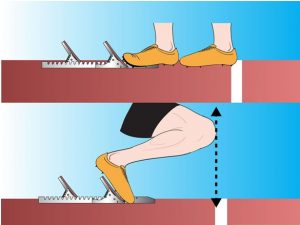
Dit is verkieslik dat ‘n atleet sy eie wegspringblokke gebruik, want dan kan al die nodige verstellings alreeds voor die werklike item gedoen word. MAAR die meeste atletiekstadions en -kompetisies vereis dat atlete van hulle blokke gebruik moet maak…daarom is dit belangrik dat atlete oefen om blokke te verstel en reg op die baan te plaas! Die middelste wegspringhouding word hier beskryf!

Die algemene reëls is dat die sterkste been voor moet wees. Verder moet die blokke/voetstukke se hoeke as volg wees: voorste blok: 60° en agterste blok: 80-85° Die voorste en agterste blokke moet ongeveer een voetlengte uitmekaar wees.

Die plasing van die blokke op die baan kan ook deur die atleet se voetlengte bepaal word, nl. twee voetlengtes vanaf die wegspringstreep! Sommige atlete gebruik ook die lengte van hul voorarms as maatstaf om die blokke te plaas.   As die blokke reg geplaas is, behoort die atleet die voorste been se knieg te       kan sak om presies op die wegspringstreep te wees. Maar in die wegspring posisie is die knieg reg onder die atleet en direk tussen die elmboë.

Wanneer daar om ‘n draai weggespring word [150m,200m,400m] word die blokke aan die buitenste deel van die betrokke baan geplaas, skuins na binne         om sodoende die draai direk voor die wegspringstreep te “sny”.

Wegspringblokke

  1. Gereed-posisie

Nadat die atlete die bevel kry “op julle merke” en almal gemaklik en stil is, kom die bevel: “Gereed”. Nou moet die atleet sy liggaamsswaartepunt so lig dat ‘n effektiewe dryf uit die blokke kan plaasvind. Dit word gedoen deur die agterste knieg van die grond te lig.

Dus moet heupelyn hoër as die skouerlyn wees en op so ‘n hoogte dat wanneer die atleet die blokke verlaat, daar nie ‘n daling of styging in die heuplyn sal wees nie! Deur hierdie beweging [om die heupe te lig] sal die skouers nou effens oor die wegspringstreep beweeg. Die gewig word nou na die bene-, arms- en skouerspiere verplaas.

Die onderbene moet naastenby parallel met mekaar wees en die voorste been moet ongeveer 90° gebuig wees!

Die kop word in ‘n natuurlike lyn met die borug gehou en die oë fokus op ‘n punt ongeveer 50cm voor die wegspringlyn. Die atleet moet dus nie opkyk na die wenstreep nie!

Net soos die atleet sy liggaam in die regte houding moet plaas, moet sy/haar asemhaling ook reggekry word om ‘n vinnige wegspring te bewerkstellig: Die asem word gedurende die opwaartse beweging van heupe ingetrek!

  1. Pistoolskoot/wegspring

Die doel van hierdie fase is om op die skoot te reageer met die minste verlies van tyd en om so gou moontlik te versnel tot maksimum snelheid.

Die arms wat die grond verlaat, is die eerste beweging wat plaasvind. Daarmee saam dryf albei die voete eksplosief teen die wegspringblokke! As die regtervoet agter is, sal die linkerarm reguit voorentoe beweeg en die ander arm, met elmboog teen 90° gebuig, na agter. Altwee die arms moet naby aan die liggaam beweeg!

Die asem word nou uitgeblaas, want die hele liggaam is in die proses om krag toe te pas – sodat die liggaam vanuit die rustende/stilstaande posisie gedryf kan word!

Die voorste been bly krag teen die blok toepas totdat die knie- en enkelgewrigte ten volle gestrek is. Die agterste voet moet nie te hoog opgetel word in die proses om na vore te beweeg nie – dit moet parallel met die grond deurkom. Dryf vorentoe uit die blokke – nie op nie!

Die kop/oë kom eers na 20m op en kyk dan na die wenpaal.

Wegspring

Bibliografie

  1. Jonath,U., Haag,E., Krempel,R. Atletiek. Uitgeverij Elmar b.v. ,                       Rijswijk. 1977
  2. Kriel, Hennie. Die wegspring, ‘n artikel uit 1988 Nasionale                                Atletiekafrigtersimposium, Boek No7.
  3. Van Niekerk, Owen. Die Naellope. Atletiekafrigting Uitgawe 5,                          Norstein Print & Paper.