Hurdles: The only OBSTACLE is your own thoughts/mental images
Witten by Jan-Hendri Smit, VSAAV Level III
“Our life is what our thoughts make it” –Marcus Aurelius
To a great extent we are what we think. Our thoughts do not only have an emotional impact on us but it also has a profound effect on our physical-biological make-up. In the book, switching on your brain, Dr Caroline leaf explains how thoughts can control the brain’s sensory processing, rewiring of the brain, neurotransmitters, genetic expression and cellular activity in either a positive or negative direction. For something that has such an enormous impact on our lives and bodies, I would say we pay far too little attention to our thoughts. If we put as much effort into mental training as we do physical training, athletes could surely improve enormously.
Now, for the how’s.
First and foremost, we need to start by focussing our attention on the ruminating thoughts going around in our minds. We need to recognize our negative thoughts, take them captive and replace them with positive thoughts.
Focused attention is a powerful ability and is attained through conditioning and disciplining the mind, gently taking thoughts captive, adjusting the thoughts on the task at hand and bringing it back from wandering. You are in fact directing you attention away from the negative, towards the positive and you are physically rewiring healthy new circuits in your brain. This leads to impressive improvement in cognitive functioning and emotional balance.
The next step is to replace these thoughts with new ones and conditioning the mind so that it becomes the norm. Patterns of habit are formed in your subconscious mind by repeating a thought or act over and over again, with a relaxed mind, until it takes root in the subconscious mind and therefore become ‘automatic’, meaning that it does not require much thinking or concentrating, because it becomes ‘instinct’ or ‘natural’, just like driving a car or a bicycle becomes second nature. This is exactly the way in which we should train our brains for a race.
Visualisation is the way in which we accomplish this conditioning of the brain. Whatever mental picture, backed by faith, and thought, that you hold and repeatedly feed on, your subconscious mind will bring to pass, for it recognizes it as important enough to hold onto and execute. In Power of the subconscious mind, Dr. Joseph Murphy says: that every thought is a cause and every condition an effect. Visualisation should be done on a regular basis. When visualising, there are a few key pointers to keep in mind. One should be completely relaxed and in a comfortable private setting for it to be effective. One should try and keep thoughts from wandering and focus completely on the task at hand. It is very important to visualize attaining your goal, every step of the way, from start to finish, the more detail you include in this mental video, the better. Remember to keep every step positive, fluent, yet realistic. The more emotion that is put into the exercise, the better it will be remembered, try to make the visualisation feel as real as possible, focus on the emotional as well as the physical experiences and feelings. Also remember that as you train, you will race. Mental toughness during training sessions is just as important as in the race itself.
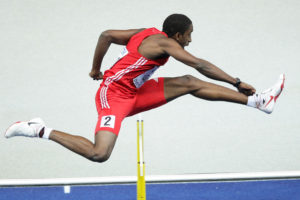
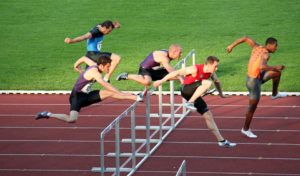
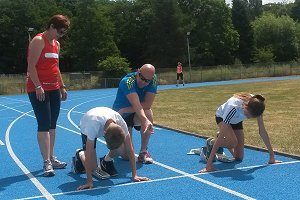
Therefore a hurdle athlete must be coached to do visualisation at least two times a week and definitely the day before a race. The athlete needs to visualise on the start and how they drive out of the blocks, the approach toward the hurdle, how they clear the hurdle (the drive, leading and third leg action) and their focus after clearing the hurdle towards the next hurdle. They need to visualise on their running technique, keeping their hips up high throughout the start till the finish.
Now, for the race itself. Just as focused attention on thoughts were important for training, focused attention is important on race day and especially during the race. But this comprises a different type of focus, not a focus on thoughts, but rather a focus on NOT thinking, clearing the conscious mind in order for the subconscious to take over, trusting the brain and body to now execute what it was trained and conditioned to do. What we say and do is based on what we have already built ‘into our minds’. We evaluate the information around us and we then make our choices based on the vast amount of information locked away in our subconscious brought forward to our conscious.
In the book, Zen and Japanese culture, about the mindset of Japanese sword fighters, who in those times fought until death, Daisetz T Suzuki wrote the following about focussing attention and staying in the zone:
“ A mind unconscious of itself is a mind that is not at all disturbed by effects of any kind. It is a state of not-thinking, emptiness, no-mindedness, mind of no mind’ “
“To clear the mind from all useless rubbish and to turn the consciousness into automation in the hands of the unconsciousness”
“The feeling of separating my body from my conscious mind and letting my body do what comes naturally”
“if you take notice of the enemy’s personality you cease to be master of yourself and are sure to fall victim to the enemy’s sword”
“Childlikeness has to be restored with long years of training in the art of self-forgetfulness. When this is attained, man does his great works. He thinks, yet he does not think”
Now I would like to direct your thoughts to hurdle athletes, in particular.
Running hurdles comprises of a whole lot of different emotions and fears than say for instance running long distances or a flat out sprint, because perfect technique is such a big added element to this race. This includes emotions of fear of falling, fear of getting disqualified, fear of getting hurt, fear of being too tired to even get over the hurdle, fears of not getting your steps in and the fear of losing balance. In my opinion visualisation is thus even more important for hurdle athletes, not only visualising mental toughness, but visualising flawless technique and rhythm. In this article I have mentioned a lot about how important conditioning of the brain is in order for activities to become instinct or second nature and that is exactly what we need when running hurdles. We need to condition the mind by training perfect technique and rhythm over and over again, as well as visualising it, in order to imprint a mental image that can be recalled during a race. During the race itself however we don’t want thoughts or thinking to be a distraction, but rather keep a focus of empty-mindedness in order for the subconscious to take control and execute what it was conditioned for, because it knows best.
The visualisation phase must consist of the following:
- The acceleration from the start to the first hurdle,
- The focus of getting a three phase rhythm between hurdles,
- The correct approach towards the hurdle,
- A high hip position of running,
- The bended leading leg,
- A comfortable running position over the hurdle,
- Having a fast and aggressive landing,
- The significant pose between the leading and driving leg,
- Having your drive leg as high as possible when it comes through.
Make visualisation part of your athletes training in order for the subconscious to take control and execute what it was conditioned for, because it knows best.
“Our life is what our thoughts make it.”