Speed vs. Power Jumpers in High Jump, Part II


 By Annerine Wenhold, ASA Level II and VSAAV Level III

Introduction

This article serves as a continuation of the discussion on the importance to distinguish between different types of high jumpers. In Part I, the importance of both speed (velocity) and power (force) as key high jump variables were discussed.  The mechanics of the jump – with a specific focus on the speed and force variables – and how the different applications thereof in jumpers can be identified – were investigated. It was argued that by sub-categorising jumpers, improved specialisation and individualisation of training can be obtained.

Part II of this article will build on this foundation, and provide further material for practical consideration and application in athlete development. These were derived from my own time as an athlete and coach, and supported by literature.

The importance of other training components, such as case specific high jump technique and periodisation, has purposefully been excluded from this discussion.


Key physiological components towards continual jump improvement

There is no single piece of advice towards an optimal training program, as each athlete operate in a specific environment with and have a unique force-velocity-coordination-stability profile. The difference of an individual’s physiological make-up (including jumper size, strength, body type, limb lengths, and fast twitch fibre ratio) will furthermore predictably determine what type of training stimuli he/she responds best to.

As a starting point, let us consider which key components must be addressed to continually improve jump performance:[i]

Jump 1

Figure: Key physiological components towards jump improvement

The first component, specific work capacity, refers to building a tolerance/ability to jump maximally and in sufficient volume to deliver repeated results. This needs careful consideration in the program periodization.

The second component is speed (velocity), with a focus on the acceleration component. As argued in Part I, this component is crucial, and improvement of the controlled velocity at plant and take-off – if all other variables stays constant – will result in jump improvement.

The third component refers to the rate of force development to enable the jump. Note that its focus is not merely on force itself, but the ability to translate this force into vertical velocity.

Let’s look at the velocity and force components in more detail; with advice generic in nature to be applicable to both the speed and power jumper:

To sprint or not

This is a no brainer – as illustrated in Part I, velocity is a key element of jumping, and as such should form part of any jumpers program. Short sprints remain the best way to develop and maintain sprinting speed,[ii] and jumps at speed is key.

For those jumpers needing improvement in max velocity, flying sprints (gradually acceleration coupled with high velocity sprints in a relaxed state) will be beneficially. For those needing force, a combination of accelerations, absolute speed and starts are recommended.

To lift or not

The benefits (or not) of lifting for the high jumper has been the debate around various coffee tables. The intention of gym work should however not only be towards gaining of strength, but rather to transfer skills to the event. Various benefits could be realised, including improvement of inter alia: posture and body awareness, coordination, joint stability, strength at key joint angles and torques, energy– laying the foundation for speed, jump and power progression.i,[iii],[iv],[v]

Both speed and power jumpers rely on a strength base to add stability to absorb eccentric forces created on planting and generate force to the ground at plant. Improving the athletes short response explosive ability will improve the jump.[vi],[vii]

Emphasis should be on exercises which will promote the greatest force over the range of motion at plant. Generic speaking, to be most effective, strength training should be in the 60-80% range (hypertrophy) and should be coupled with plenty of explosive plyometrics (0-30%), and reactive strength training (including speed drills and jumping).  Care should be taken towards correct lift mechanics and doing the lifts at manageable volumes.

Focus should be on max, explosive and reactive strength improvement. Essentials are:

  • Barbell hip thrusts to activate the glutes.
  • Olympic lifting for hip extension.
  • Ankle rocker drills (to improve the ability of the ankle or body to get the centre of mass through the mid-stance phase and create forward movement).[viii]
  • Tendon enhancement for plant maximisation.
  • Doing plenty of lifts with extension of the plantar flexion.
  • Supersets combining lifting with plyometrics has been found to be especially effective (and enjoyable).

Specific training interventions

Specific training interventions for speed and power jumpers are outlined below:
Jump 2

Speed jumper do’s

Usually your lanky athletes, these individuals have the advantage of a high centre of gravity (typically at hip height) at the initiation of the jump, and must build on that advantage by enhancing their natural strengths, which typically include strong hips and ankles, elastic strength and speed at take-off.

As a typical ectomorph[ix], these athletes might experience an initial rapid improvement via lifting, however, these results will quickly taper off (especially compared to their power Jumper counterparts). Their preference – and ability – lies in specific plyometric based movements and they will naturally take to these types of training regimes.

For strength gains, they may benefit from compound movements to maximise growth hormone release (e.g. Olympic lifts, deadlifts), plyometrics and running jumps (with a focus to reduce time at plant) and increased speed-strength training coupled with sufficient protein intake.[x]

Speed drills should form a significant portion of the training regime, and acceleration, max speed efforts and flying sprints will strengthen the velocity variable. Cardio should be limited.

Power jumper do’s

As your typical mesomorph, these athletes’ fast twitch muscles respond well to strength training. With their deeper knee bend at plant, they should do targeted strength training to ensure that their natural strength ability is fully developed and maximum power can be transferred to the jump.

They usually prefer and respond rapidly to barbell oriented movements (low volume of high intensity and power reps), and these can effectively be used. Further gains can be achieved through plyometrics and accelerative training methods (e.g. depth jumps which will improve longer response plyometric ability).ix 

As with their speed jumper counterparts, speed drills should form a significant portion of the training regime, and acceleration, max speed efforts and flying sprints will strengthen the velocity variable.

Further force-velocity training recommendations

Regardless of being a power/speed jumper, each athlete will have a unique force-velocity profile. Within their ability range, plenty of athletes are imbalanced towards either force or velocity, and an individualised training program to address the weaknesses is needed.[xi]  Consider to:

  • Apply Michael Yessis’s 1×20 training regime for high schoolers.[xii],[xiii]
  • Improve the athlete’s ability to yield a high force value in the plant by performing exercises such as a seated box jump.
  • Improve accelerative strength (velocity of ca. 0.5-0.7m/s) by performing a heavy compound movement (e.g. barbell squad/deadlift).
  • Improve strength-speed by using the Dynamic Effort Method (at ~0.8-1m/s velocity -dependant on the type of exercise); effort in the 20-60% range.
  • Improve reactive strength through depth jumps.
  • Improve isometric and trunk strength to prevent force leakage.
  • Perform deceleration based movements (with an eccentric emphasis), including high altitude landings with jumps or velocity overload exercises like Kettle Bell power bomb swings.
  • Improve force ability transfer by targeted sledge work on the track (max and acceleration based speed drills).
  • Remember full approach high jumps.Other exercise components must be kept in the program towards its building or maintenance. Keep in mind that all movements have a strength, speed and skill component, and where possible, these must be manipulated to improve the high jump range of movements.

Conclusion

No matter what your athletes’ dominant qualities are, improvement in jumping performance rely on targeted speed and strength training at such a volume and intensity to promote adaptation and progression. The relative ratio and nature thereof will differ based on the athlete’s individual ability and make-up.

The differentiation in exercise regime for your speed and power jumpers will be to their advantage. Further consideration towards technique application is required.

References

[i] Smith, Joel. “7 Philosophies on Increasing Vertical Jump Skill and Power”, Freelap, https://www.freelapusa.com/7-philosophies-on-increasing-vertical-jump-skill-and-power/, viewed 8 March 2017

[ii] Korfist, Chris. “5 Drills to Improve Vertical force and run really fast”, Freelap, https://www.freelapusa.com/5-drills-to-improve-vertical-force-and-run-really-fast/, viewed 14 March 2017

[iii]Strength Training Session”, Sport Fitness Advisor, http://www.sport-fitness-advisor.com/strengthtraining.html, viewed 14 March 2017

[iv]Health and Fitness for the future”, Fit Dyanmics, http://www.fitdynamics.com/gpage.html, viewed 14 March 2017

[v] Dionne, Cassie. “7 Reasons youth athletes need to strength train”, Breakingmuscle.com, https://breakingmuscle.com/learn/7-reasons-youth-athletes-need-to-strength-train, viewed 14 March 2017

[vi]Jump Training Lesson 3 – Individuality and Jumping Styles”, Higher-Faster-Sports.com, http://www.higher-faster-sports.com/jumptraininglesson3.html, viewed 22 February 2017

[vii] Dick, Frank W. ‘High Jump”, 9th edition, 1993

[viii] Korfist, Chris. “How to improve ankle rocker range of motion”, Freelap,  https://www.freelapusa.com/how-to-improve-ankle-rocker-range-of-motion/, viewed 6 February 2017

[ix] Snape, Joel. “Ectomorph, Endomorph and mesomorph: How to train for your body type”, Coach, 21 December 2016

[x] http://www.coachmag.co.uk/lifestyle/4511/ectomorph-endomorph-or-mesomorph-what-is-your-body-type, viewed 13 March 2017

[xi] Salwasser, Scott. 3 March 2017, “Optimizing Sprint & Jump Training Based on Individual Force-Velocity Profiling”, Just Fly Sports, http://www.just-fly-sports.com/training-based-individual-force-velocity/, viewed 5 March 2017

[xii] Yessis, Michael. “The revolutionary 1×20 strength training programme”, 2013

[xiii] DeMayo, Jay. Central Virginia Sport Performance, “Our program for the high school level”, http://www.cvasps.com/wp-content/uploads/2014/05/Our-Program-For-High-School-Athletes.pdf, viewed 22 March 2017


Speed vs. Power Jumpers in High Jump, Part I


By Annerine Wenhold, ASA Level II and VSAAV Level III coach

 Introduction

As coaches, we all know the importance of providing coaching based on an athletes individual needs. But do we really apply this in practice?  We often group our athletes together and train them on a single ‘best-practice’.

In this article, the importance of both speed and power as key high jump variables will be discussed. I will argue that it is necessary to distinguish between the so-called speed and power jumpers in training.  This will be substantiated with the mechanics of the jump (with a specific focus on the power and speed variables) and the sub-categorisation of jumpers based on the application of speed and force in their jumps as well as their body types.

Part II of this article will build on this foundation, and provide further material for practical consideration and application in training.  The importance of other training components, such as periodization, has purposefully been excluded from this discussion.

Note that for the purpose of this article, the terms of speed and velocity, as well as force, power and strength are being used interchangeably.


Mechanisms of high jump

Speed (velocity) and power (force) as well the direction of its application are important variables in the quest for increased height. These variables will be discussed at the hand of the following jumping phases:[i]

Phase 1: Jumper starting the approach and gradually accelerate towards the control point.

Phase 2: As second phase of the approach, accelerating in an arc towards the bar.

Phase 3: Projectile motion of the jumper off the ground towards clearance of the bar.

The role which speed and force play in each of the phases will now be discussed.

The case for speed (velocity)

Speed (velocity) plays an important role in all three jumping phases.

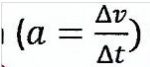
In the run-up, controlled horizontal velocity is important to set the jumper up towards the acceleration into the jump and the jump itself. The acceleration equation Formule 1  with a the acceleration and v the horizontal velocity over time (t) applies.
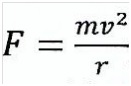
In the second phase, the centrifugal force (F) is crucial. Defined as Formule 2 , where v is again the horizontal velocity (r the radius of trajectory and m the athlete’s mass), an increase in horizontal velocity will directly have a positive impact on the angular momentum. 
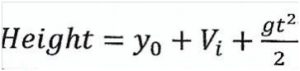
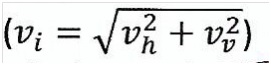
The jumper’s centre of mass path through the air follows a parabolic trajectory towards the clearance of the bar (third phase)   This path is velocity dependant, and characterized by a constant horizontal velocity (obtained through the approach run) and constant downward acceleration (due to gravity).[ii],[iii] The standard projectile motion equation from Newtonian mechanics provides insight into the relationship between these elements towards optimal height: Formule 3  ,[iv] where y0 is the distance that the athletes centre of mass is from the ground, Vi is the initial velocity prior to the jump. This velocity is determined by both the horizontal velocity obtained through phases 1 and 2 of the jump, and the vertical velocity before the jump

Formule 4 g is the gravitational forces, t is the time
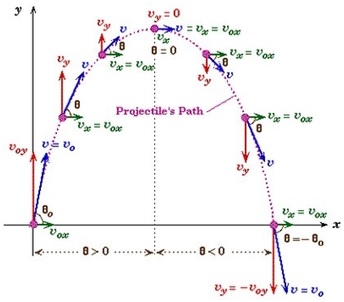
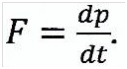
 Foto 3 Deel I

Figure: Parabolic flightpath of a high jumper

Thus, the horizontal velocity at plant will influence the vertical velocity and therefore the height reached in the jump.

The case for power (force)

All of Newton’s laws of motion applies to high jump. In the approach (phases 1 and 2), overcoming inertia (Newton’s 1st law), then accelerating towards the bar (2nd law), and lastly during the plant (3rd law – for every force there is an equal in quantity but opposite in direction), force is required.

Combining Newton’s 2nd law of motion (F=ma, F=force in direction of acceleration and m the athlete’s mass) equation with the momentum equation, results in Formule 6. Thus, force is redefined as the rate at which the momentum is change (the angular momentum).
Furthermore, the rate of change in momentum is directly proportional to the resultant force applied with movement being in the direction of this force.

Thus, the force applied at plant will influence the vertical velocity and therefor, as previously with speed, the height reached in the jump.

A balancing act

For an optimal jump, a balance needs to be achieved between force impartation over the greatest range of motion. This needs to be achieved over the least amount of time (thus highest velocity) at the time of plant.

Furthermore, the jumper can only influence the momentum and parabolic trajectory up to the point of plant. The velocity of the approach, and the steepness of the launching angle will contribute to the parabola of flight. Once off the ground, the centre of mass’s parabolic curve (including its angle as well as velocity) is unchangeable.

The posture of the athlete at plant will thus influence the amount of force and velocity that are transferred into the jump, as well as the parabolic trajectory. With a deeper knee bend at plant, more force can be applied. Whilst with less flexion in the knee, as well as less time spend on plant, an increased amount of horizontal velocity can be maintained and transferred to generate the vertical lift.[v]

Individual make-up and identification of the different types of jumpers

Jumpers can thus manipulate these variables towards gaining height. Based on the individual make-up of your jumper, the relative contribution of these variables will differ.  This difference have contributed to the sub-categorization of jumpers into two distinct categories:  speed and power jumpers.

So how can these jumpers be identified? To answer this question, it is necessary to look at their genetic and central nervous system tendencies, including body type:

Foto 1 Deel I          Foto 2 Deel I

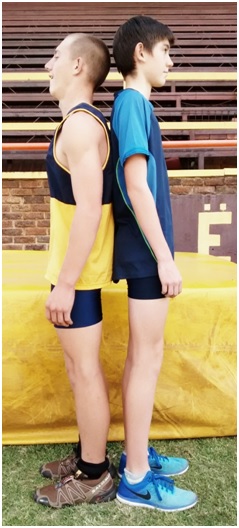
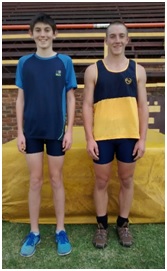
Figure B: Edric (13yrs) and Pieter (15yrs) displaying the Ecto- and Mesomorph body types[vi], [vii] 

Speed jumpers

Speed jumpers are typically those gifted in the structural department, with long legs and Achilles tendons, small joints and a low body fat percentage. As a typical ectomorph, they might find it difficult to build muscle – and thus to influence the power variable in their jump considerably. These jumpers usually rely on their reactive ability (elastic strength), and naturally favours the least amount of time at plant.

In the approach, they by and large run with tall hips and good mechanics (if that skill has been acquired). Their last step toward take-off will typically be with little knee bend (and lowering of the centre of mass) to allow for the rapid take-off contact. They use their ankles and hips well in the last portion of the bar clearance by extending their ankles and hips completely and quickly.  They are the hip dominant jumpers with strong ankles to allow for the short amortization phase (the time spend changing direction as you are on the ground just before a very fast take-off).

Another way to identify this type of athlete will be by looking at his/her other events, as they typically excel in sprints, long jump or hurdling.

Power jumpers

Power jumpers are generally naturally stronger in the lower body, with thicker muscles and joints. Leaning more to the mesomorph body type,iv,v these athletes typically have high metabolisms, can build muscle easily due to responsive muscle cells but can also gain fat easier than their ectomorph counterparts. With their natural power, they favour a larger degree of range of motion at the plant in order to apply their absolute strength and explosive power.  This is evident in a deeper knee bend before take-off.

It is worth noting that body types and its tendencies aren’t set in stone, and many talented jumpers are a combination of the ectomorph/mesomorph body types,vii and may display a combination of the factors presented above based on their unique characteristics.

Considering the exceptions

Strength as a physical characteristic is best developed after puberty. Woman – with higher percentage of elasticity than strength[viii] – and youth will thus typically favour the velocity take-off mechanisms.

In Conclusion

Both velocity and force are important variables in high jump, and the athlete who is best equipped to apply most force in the shortest period of time will jump the highest. The relative contribution of these variables towards an optimal jump will vary between jumpers, and needs to be considered in athlete development.

The speed jumper is your typical hip dominant jumpers who will rely on their velocity and ectomorph build to gain jumping height. The power jumper on the other hand, with their higher natural strength level and potential lesser speed, are knee dominant and will apply that force in the jump.

References

[i] Smith, Joel. “7 Philosophies on Increasing Vertical Jump Skill and Power”, Freelap, https://www.freelapusa.com/7-philosophies-on-increasing-vertical-jump-skill-and-power/, viewed 8 March 2017

[ii] Stone, Glen. “Projectiles”, High Jump Coach, High Jump On-line book, http://www.highjumpcoach.com/HJCbook/Phy/Proj, viewed 13 March 2017

[iii] Mohan, Rajagopalan. “Dev Blog: Designing a Jump”, AtomJack, August 11, 2014, http://www.atomjack.net/blog/2014/12/9/dev-blog-designing-a-jump, viewed 13 March 2017

[iv] Cooke, Paige. “High Jump Analysis”, Undergraduate Journal of Mathematical Modelling: One+Two, Volume 5, 2012 Fall, Issue 1, Article 4, http://scholarcommons.usf.edu/cgi/viewcontent.cgi?article=4849&context=ujmm, viewed 13 March 2017

[v] Dick, Frank W. ‘High Jump”, 8th edition, 1980

[vi] Snape, Joel. “Ectomorph, Endomorph and mesomorph: How to train for your body type”, Coach, 21 December 2016,

http://www.coachmag.co.uk/lifestyle/4511/ectomorph-endomorph-or-mesomorph-what-is-your-body-type, viewed 13 March 2017

[vii] Your Body Type – Ectomorph, Mesomorph or Endomorph?”, MS, https://www.muscleandstrength.com/articles/body-types-ectomorph-mesomorph-endomorph.html, viewed 13 March 2017

[viii] Dick, Frank W. ‘High Jump”, 9th edition, 1993


Jaarindeling: BAANITEMS


deur Rudolph Cloete, VSAAV en ASA Vlak III

Elke atletiekitem het sy eie vereistes wanneer dit kom by wat in elke deel van die jaar geoefen moet word. Dit gaan nie net oor die wat nie, maar ook oor die hoeveel wat geoefen moet word. Elke fase in die jaar is in 2 gedeel. Die oefeninge loop op tot by Kompetisie-fase se deel 2.


NAELLOPE [100 – 200M] FASE          
OEFENPLAN: Konditionering Voorbereiding Kompetisie
JANUARIE – APRIL 1 2 1 2 1 2
Spieruithouvermoë/ Stamina 30% 25% 20% 15% 10% 10%
Spoeduithou 5% 5% 10% 10% 15% 15%
Krag 15% 15% 15% 15% 20% 20%
Spoed 5% 10% 15% 20% 20% 20%
Tegniek “drills” 30% 30% 20% 20% 15% 10%
Koördinasie “drills” 10% 10% 10% 10% 5% 5%
Aktiewe rus en Motivering 5% 5% 10% 10% 15% 20%
TOTAAL 100% 100% 100% 100% 100% 100%


NAELLOPE [400M] FASE          
OEFENPLAN: Konditionering Voorbereiding Kompetisie
JANUARIE – APRIL 1 2 1 2 1 2
Spieruithouvermoë/ Stamina 30% 30% 25% 25% 20% 10%
Spoeduithou 5% 10% 15% 20% 20% 20%
Krag 15% 15% 15% 15% 20% 20%
Spoed 5% 10% 15% 15% 15% 20%
Tegniek “drills” 20% 15% 10% 5% 5% 5%
Koördinasie “drills” 20% 15% 10% 10% 5% 5%
Aktiewe rus en Motivering 5% 5% 10% 10% 15% 20%
TOTAAL 100% 100% 100% 100% 100% 100%


HEKKIES FASE          
OEFENPLAN: Konditionering Voorbereiding Kompetisie
JANUARIE – APRIL 1 2 1 2 1 2
Spieruithouvermoë/ Stamina 30% 25% 20% 15% 10% 10%
Spoeduithou 5% 5% 10% 10% 15% 15%
Krag 15% 15% 15% 15% 20% 20%
Spoed 5% 10% 15% 20% 20% 20%
Tegniek “drills” 30% 30% 20% 20% 15% 10%
Koördinasie “drills” 10% 10% 10% 10% 5% 5%
Aktiewe rus en Motivering 5% 5% 10% 10% 15% 20%
TOTAAL 100% 100% 100% 100% 100% 100%


MIDDELAFSTANDE FASE          
OEFENPLAN: Konditionering Voorbereiding Kompetisie
JANUARIE – APRIL 1 2 1 2 1 2
Spieruithouvermoë/ Stamina 75% 60% 50% 50% 25% 20%
Spoeduithou 0% 10% 10% 15% 25% 35%
Krag 20% 20% 25% 25% 25% 15%
Spoed 0% 0% 5% 5% 10% 10%
Aktiewe rus en Motivering 5% 10% 10% 15% 15% 20%
TOTAAL 100% 100% 100% 100% 100% 100%


Bron:             ASA Coaches Education and Certification System


Jaarindeling: SPRONGE


deur Rudolph Cloete, VSAAV en ASA Vlak III

Elke atletiekitem het sy eie vereistes as dit kom by wat in elke deel van die jaar geoefen moet word! Dit gaan nie net oor die wat nie, maar ook oor die hoeveel wat geoefen moet word.

Elke fase word in 2 dele gedeel en dit bou op tot by die Kompetisie-fase se deel 2, wat saam met die SA Kampioenskap gaan val.

Bron:        ASA Coaches Education and Certification System


HOOGSPRING

FASE
OEFENPLAN:  Konditionering Voorbereiding Kompetisie
JANUARIE – APRIL 1 2 1 2 1 2
Spieruithouvermoë/ Stamina 20% 15% 10% 10% 10% 5%
Spoeduithou 5% 10% 15% 15% 15% 15%
Krag 30% 25% 25% 25% 20% 20%
Spoed 5% 10% 15% 15% 15% 15%
Tegniek en Ritme 35% 35% 30% 30% 25% 25%
Aktiewe rus en Motivering 5% 5% 5% 5% 15% 20%
TOTAAL 100% 100% 100% 100% 100% 100%
 

DRIESPRONG

FASE
OEFENPLAN Konditionering Voorbereiding Kompetisie
JANUARIE – APRIL 1 2 1 2 1 2
Spieruithouvermoë/ Stamina 30% 25% 20% 15% 10% 5%
Spoeduithou 5% 10% 15% 20% 15% 15%
Krag 10% 15% 20% 20% 20% 20%
Spoed 5% 10% 15% 20% 20% 25%
Tegniek en Ritme 45% 35% 25% 20% 20% 15%
Aktiewe rus en Motivering 5% 5% 5% 5% 15% 20%
TOTAAL 100% 100% 100% 100% 100% 100%
 

VERSPRING

FASE
OEFENPLAN:  Konditionering Voorbereiding  Kompetisie
JANUARIE – APRIL 1 2 1 2 1 2
Spieruithouvermoë/ Stamina 30% 25% 20% 15% 10% 5%
Spoeduithou 5% 10% 15% 20% 15% 15%
Krag 5% 10% 15% 20% 20% 20%
Spoed 5% 10% 15% 20% 20% 25%
Tegniek en Ritme 50% 40% 30% 20% 20% 15%
Aktiewe rus en Motivering 5% 5% 5% 5% 15% 20%
TOTAAL 100% 100% 100% 100% 100% 100%


Beginsels van programmering


deur Rudolph Cloete,  ASA en VSAAV Vlak III

1. INLEIDING

As daar een plek in ons skoolatleet se mondering is wat ernstige aandag nodig het, dan is dit programbeplanning. Omdat daar gewoonlik meer as een afrigter by die atleet betrokke is, lei die oorhoofse beplanning van die atleet se beskikbare oefentyd daaronder! Die vader van programmering is die Rus, L.P. Matveyer! Sy boek “Periodization of Sports Training” (1965) was die handboek vir baie jare. Die Westerse wêreld het eers werklik in 1975, na ‘n klompie artikels deur Frank Dick, die beginsels begin toepas.

Programmering is dus niks nuut nie! Programmering/Periodisering is die beplanning van die atleet se beskikbare tyd om te verseker dat al die komponente wat ingeoefen moet word, wel die nodige tyd, aandag en belading kry. “Periodization is simply dividing an athlete’s training program into a number of periods of time, each with a specific training goal” (Freeman, p1)

  1. BEGINSELS VAN PROGRAMMERING

          2.1     INDIVIDUALITEIT

Dit is die eienskappe wat een atleet van ‘n ander onderskei. Atlete wat kampioene in alles navolg, het geen individualiteit nie. Een atleet mag baie spoed hê, maar min krag, terwyl ‘n                   atleet net die teenoorgestelde eienskappe besit: Dit sal onsinnig wees om albei op dieselfde program te laat oefen! Die oefenprogram moet by elke individuele atleet se behoeftes pas.

          2.2     OORBELADING (“Progressive overload”)

Oorbelading

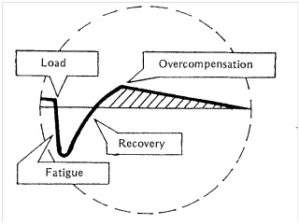
Hierdie beginsel wil sê dat ‘n verbetering in die atleet se fiksheid  slegs behaal kan word deur ‘n progressief, swaarderwordende oefenbelading. Wanneer ‘n atleet oefen veroorsaak die belading ‘n respons in die atleet se liggaam. Indien die belading normaal is, sal die  liggaam/spier uitgeput word en na ‘n rusperiode terugkeer na die normale fiksheidvlak van die liggaam/spier.Indien die belading egter swaarder as die normale is, sal die liggaam/spier na ‘n rusperiode na ‘n hoër vlak van fiksheid terugkeer…hierdie oorkompensasie veroorsaak dat die liggaam/spier fikser, sterker, vinniger word!

          2.3     SPESIFISITEIT

Die beginsel sê dat die aard van die oefenbelading die gewensde oefeneffek veroorsaak.. Om effektief vir ‘n item te oefen, beteken dat       die oefenprogram so saamgestel sal word dat dit die spesifieke vereistes van die item sal aanspreek. Prestasieverbetering is dus op die beoefening van die spesifieke item gebaseer!

Dus bepaal die item watter oefeninge in die oefensessie ingesit moet word: Dit help nie die Verspringatleet doen baie/gevorderde bankopstote met sy arms nie …hy/sy kort die krag in sy bene!

          2.4     OMKEERBAARHEID (“Reversibility”)

Hierdie beginsel wil hê dat die fiksheidsvlak van ‘n atleet sal afneem indien die belading ophou! In wese beteken dit dat die oefeneffek wat verkry is, sal omkeer en wegraak indien die spesifieke belading weggeneem word! As die atleet dus vir ‘n maand kragwerk gedoen het en hy kap diè komponent ‘n maand voor die kompetisie uit sy program, sal die atleet al die krag wat hy opgebou het, verloor en tydens kompetisie net so sterk wees so asof hy nooit kragwerk gedoen het nie.

Dus moet alle komponente van spesifisiteit dwarsdeur die jaar gehandhaaf word : Indien gewigte gedoen word, maar dit te naby aan         die kampioenskappe kom, moet die kragkomponent omgeskakel word na kraguithou-aktiwiteite! Dit moet egter nie heeltemal gestaak word nie.

          2.5     RUS/HERSTEL

Die meeste van die atlete (en afrigters!) wil net oefen en oefen! Ongelukkig kan hulle meer skade deur ‘n swakbeplande harde oefensessie doen as wat hulle besef…en die probleem is dat hulle nie         die beginsel van rus/herstel respekteer nie. Oefening breek die spier fisiologies af en daar moet ‘n periode van rus ingebou word sodat herstel kan plaasvind. So nie vind ooroefening plaas, stressfakture (e.a. beserings) steek sy kop uit.   Oorgebruiksindroom veroorsaak ‘n verlies aan oefentyd en die spier kan nie volgens sy maksimale vermoë presteer nie!

By die eksplosiewe items sal daar nie twee oefeninge, wat dieselfde spiergroep teiken, na mekaar geoefen word nie. So sal twee bv. gewigte-oefensessies ook nie op agtereenvolgende dae gedoen word nie!

  1. INDELING VAN DIE OEFENJAAR 

Jaarindeling

Makrosiklus: Daar is 2 makrosiklusse in die jaar, nl. September – November en dan weer Januarie – Maart/April. Ons noem dit ‘n dubbelpiekjaarprogram.

Mesosiklus: Die eerste makrosiklus bestaan uit 3 mesosiklusse, nl. Oorgangsfase, Voorbereidingsfase en ‘n Kompetisiefase. Die tweede makrosiklus bestaan net uit laasgenoemde 2 mesosiklusse. Dus is daar 5 sulke mesosiklusse in die volle oefenjaar, met die 2 mesosiklusse in Januarie – Maart/April, wat die belangrikstes is.

Mikrosiklus: Dit is ongeveer gelykstaande aan ‘n week: 6 oefendae + die 7de dag moet jy rus! Dit is hier waar die indiwiduele oefeninge ingepas moet word.

  1. BEPLANNING 

4.1     Begin die beplanning by die topbyeenkomstes – wat in November en in Maart/April gaan plaasvind …en werk terug na September en Januarie onderskeidelik.

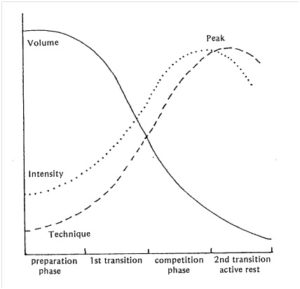
Piek

4.2     Volume sal hoog wees in September/middle Oktober en afneem na November. Dieselfde geld vir Januarie/middle Februarie en afneem na Maart/April.

4.3     Die teenoorgestelde sal met Intensiteit gebeur: As die Volume hoog is, is die Intensiteit laag en as die Volume afneem na November en Maart/April, sal Intensiteit styg en op sy hoogste wees!

4.3     Wanneer die Kompitisiefases aanbreek moes al die komponente wat deur spesifieke item benodig word, alreeds aandag in die verskillende oefensessies gekry het! Hier dink ons aan krag, spoed, eksplosiewe krag, algemene fiksheid, oordistansie,motivering, tegniek, ens.

4.3     Moenie haastig raak nie! Elke mesosiklus het sy mikrosiklusse  en geen kortpad moet geneem word nie:

Kortpaaie veroorsaak beserings!!! Kortpaaie veroorsaak dat die atleet nooit werklik sy potensiaal bereik nie, want deelname geskied voordat daar werklik tot op     die piek van die kurwe beweeg word. Hierdie is die een werklike groot probleem van die veelsydige skoolatleet.

4.4     Neem die atleet se volle program in ag en bewerk ‘n plan om  kontraste uit die weg te ruim…dit vereis samewerking tussen  bv. die naelloopafrigter en die verspringafrigter. Onthou dit is    die atleet wat moet vorder en nie die afrigters se “image” nie!

Die skool se atletiekafrigters moet as ‘n span funksioneer en konstante kommunikasie is uiters belangrik!


Hurdles: The only OBSTACLE is your own thoughts/mental images


Witten by Jan-Hendri Smit, VSAAV Level III

“Our life is what our thoughts make it” –Marcus Aurelius

To a great extent we are what we think. Our thoughts do not only have an emotional impact on us but it also has a profound effect on our physical-biological make-up. In the book, switching on your brain, Dr Caroline leaf explains how thoughts can control the brain’s sensory processing, rewiring of the brain, neurotransmitters, genetic expression and cellular activity in either a positive or negative direction.  For something that has such an enormous impact on our lives and bodies, I would say we pay far too little attention to our thoughts.  If we put as much effort into mental training as we do physical training, athletes could surely improve enormously.

Now, for the how’s.

First and foremost, we need to start by focussing our attention on the ruminating thoughts going around in our minds. We need to recognize our negative thoughts, take them captive and replace them with positive thoughts.

Focused attention is a powerful ability and is attained through conditioning and disciplining the mind, gently taking thoughts captive, adjusting the thoughts on the task at hand and bringing it back from wandering. You are in fact directing you attention away from the negative, towards the positive and you are physically rewiring healthy new circuits in your brain. This leads to impressive improvement in cognitive functioning and emotional balance.

The next step is to replace these thoughts with new ones and conditioning the mind so that it becomes the norm. Patterns of habit are formed in your subconscious mind by repeating a thought or act over and over again, with a relaxed mind, until it takes root in the subconscious mind and therefore become ‘automatic’, meaning that it does not require much thinking or concentrating, because it becomes ‘instinct’ or ‘natural’, just like driving a car or a bicycle becomes second nature. This is exactly the way in which we should train our brains for a race.

Visualisation is the way in which we accomplish this conditioning of the brain. Whatever mental picture, backed by faith, and thought, that you hold and repeatedly feed on, your subconscious mind will bring to pass, for it recognizes it as important enough to hold onto and execute. In Power of the subconscious mind, Dr. Joseph Murphy says: that every thought is a cause and every condition an effect.  Visualisation should be done on a regular basis. When visualising, there are a few key pointers to keep in mind. One should be completely relaxed and in a comfortable private setting for it to be effective. One should try and keep thoughts from wandering and focus completely on the task at hand. It is very important to visualize attaining your goal, every step of the way, from start to finish, the more detail you include in this mental video, the better. Remember to keep every step positive, fluent, yet realistic. The more emotion that is put into the exercise, the better it will be remembered, try to make the visualisation feel as real as possible, focus on the emotional as well as the physical experiences and feelings. Also remember that as you train, you will race. Mental toughness during training sessions is just as important as in the race itself.

Therefore a hurdle athlete must be coached to do visualisation at least two times a week and definitely the day before a race. The athlete needs to visualise on the start and how they drive out of the blocks, the approach toward the hurdle, how they clear the hurdle (the drive, leading and third leg action) and their focus after clearing the hurdle towards the next hurdle. They need to visualise on their running technique, keeping their hips up high throughout the start till the finish.

Now, for the race itself. Just as focused attention on thoughts were important for training, focused attention is important on race day and especially during the race. But this comprises a different type of focus, not a focus on thoughts, but rather a focus on NOT thinking, clearing the conscious mind in order for the subconscious to take over, trusting the brain and body to now execute what it was trained and conditioned to do. What we say and do is based on what we have already built ‘into our minds’. We evaluate the information around us and we then make our choices based on the vast amount of information locked away in our subconscious brought forward to our conscious.

In the book, Zen and Japanese culture, about the mindset of Japanese sword fighters, who in those times fought until death, Daisetz T Suzuki wrote the following about focussing attention and staying in the zone:

“ A mind unconscious of itself is a mind that is not at all disturbed by effects of any kind. It is a state of not-thinking, emptiness, no-mindedness, mind of no mind’ “

“To clear the mind from all useless rubbish and to turn the consciousness into automation in the hands of the unconsciousness”

“The feeling of separating my body from my conscious mind and letting my body do what comes naturally”

“if you take notice of the enemy’s personality you cease to be master of yourself and are sure to fall victim to the enemy’s sword”

“Childlikeness has to be restored with long years of training in the art of self-forgetfulness. When this is attained, man does his great works.  He thinks, yet he does not think”

Now I would like to direct your thoughts to hurdle athletes, in particular.

Running hurdles comprises of a whole lot of different emotions and fears than say for instance running long distances or a flat out sprint, because perfect technique is such a big added element to this race. This includes emotions of fear of falling, fear of getting disqualified, fear of getting hurt, fear of being too tired to even get over the hurdle, fears of not getting your steps in and the fear of losing balance. In my opinion visualisation is thus even more important for hurdle athletes, not only visualising mental toughness, but visualising flawless technique and rhythm. In this article I have mentioned a lot about how important conditioning of the brain is in order for activities to become instinct or second nature and that is exactly what we need when running hurdles. We need to condition the mind by training perfect technique and rhythm over and over again, as well as visualising it, in order to imprint a mental image that can be recalled during a race. During the race itself however we don’t want thoughts or thinking to be a distraction, but rather keep a focus of empty-mindedness in order for the subconscious to take control and execute what it was conditioned for, because it knows best.

The visualisation phase must consist of the following:

  • The acceleration from the start to the first hurdle,
  • The focus of getting a three phase rhythm between hurdles,
  • The correct approach towards the hurdle,
  • A high hip position of running,
  • The bended leading leg,
  • A comfortable running position over the hurdle,
  • Having a fast and aggressive landing,
  • The significant pose between the leading and driving leg,
  • Having your drive leg as high as possible when it comes through.

Make visualisation part of your athletes training in order for the subconscious to take control and execute what it was conditioned for, because it knows best.

“Our life is what our thoughts make it.”


Op 12 Februarie 2017 bespiegel Rooimier oor atletiektabelle


Elke jaar word die skole gevra om die nuutste weergawe van die Joba-tabelle aan te koop…en elke jaar trek die tabelle al verder skeef …

In die verlede was die SASOL-tabel ‘n nuttige hulpmiddel vir die atleet, die atletiekafrigter en administrateer: die atleet kon sien waar sy prestasie op ‘n nasionale vlak inpas, die afrigter kon bv. die veelsydige atleet se prestasies teenoor mekaar opweeg en die atleet aanmoedig om op sy “beste” twee items te konsentreer en die administrateer kon verskillende items met mekaar vergelyk om in sekere kompetisies [soos Sentraal Top 20 en SASOL-reeks/Clover] die beste atlete te kies.

MAAR dit het heeltemal verander! Niks van bogenoemde is meer moontlik nie! Inteendeel, weet ek nie hoekom ons nog die tabelle het nie! Dit het nou so skeefgetrek dat dit geen weerspieling van ‘n skool se ware atletiekkrag meer meet nie!

Na elke byeenkoms kan daar ‘n Top 50-lys uitgedruk word! Ek het ‘n paar van hulle, m.a.w. van ‘n paar verskillende atletiekbyeenkomstes, bymekaar gemaak: In een byeenkoms (‘n Uitnodigingsbyeenkoms) was die beste 12 items op die lys, worpe items – waarvan een nie eers die kwalifiserende afstand vir SASA SA’s is nie! Die 50ste prestasie op die lys, Meisies /17 is ‘n Diskusafstand van 30,70: dit is 5,30m weg van kwalifikasie!! Dit verdien 769 punte op die tabel …daarteenoor kry ‘n  Meisie /15 wat die kwalifiserende afstand van 10m in die driesprong met 0.20m oorskry het, slegs 672 punte! Dus wie gaan by die huis bly as die span gekies moet word: die Vrystaatatleet natuurlik! Hoe verduidelik jy dit aan ‘n kind??? Gaan daardie Diskusmeisie enigsins onder die beste 8 atlete in die itemkompetisie kom???- maar sy is onder die top 50-prestasie op ‘n volle byeenkoms!

Kyk ons na ‘n topklasbyeenkoms (waar verskeie van SA se topskole – in ‘n spankompetisie – deelgeneem het EN waar die wenspanne d.m.v. die tabelle bereken word) dan ys mens om te sien dat die “wenspan” omtrent net uit worpe-atlete bestaan – en verseker nie noodwendig die beste atletiekspan is nie! Hier is die 18 beste prestasies op die lys, worpe-items – en slegs een daarvan is ‘n seunsitem! Dit sou nog erger gewees het indien Hamergooi ook op die program was!  Geen Paalspring-, geen Driesprong- en geen Hoogspringprestasie kry ‘n plek op een van die twee Top 50-prestasielyste nie!!! EN slegs een Verspringprestasie in die 100 prestasies op hierdie twee lyste!

Vir jare was byeenkomste, wat bepaal word deur die gebruik van tabelle, die in-ding! Ons vergeet dat die Appelreeks, en sy opvolger, die SASOL-reeks, eers deur plekke met punte bepaal was! 7,5,4,3,2,1 en niemand daarna verdien iets nie! Toe het atlete van dieselfde ouderdom teen mekaar deelgeneem en nie soos nou teen al die ander ouderdomsgroepe d.m.v die tabel nie! Nou kry tot die 15de plek (hang af wat die byeenkomsreël bepaal) nog punte! Vroeër kon jy ‘n SA rekord gebreek het, maar jy het slegs 7 punte gekry …en dit voel vir my of daar meer SA rekords – as deesdae! – wel hierdeur verbeter is!

Ek stel voor die organiseerders van die Sentraal Top 20 en die Cloverbyeenkoms in die Vrystaat moet “nuut” – of is dit “oud” – begin dink! ‘n Bietjie inisiatief sal weer alle skole ‘n billike kans gee om in sulke spankompetisies te presteer! Ek onthou nog hoe lekker dit was om so ‘n span te kies: al die statistieke van opponent, die gestry met ander afrigters om jou atleet in die span te kry, die uitoorlê van die opponente! [Dr. Sam Pellissier en Ilze van Graan was meesters daai dae!]

Ek glo dat die statistici wel goeie argument vir die huidige toestand van die tabelle sou hê, maar ons ou dom atletiekmensies sal dadelik, en duidelik, sien dat die tabelle nie meer meet wat dit veronderstel is om te meet nie. Vir my is die dae van tabelle vir skoolatlete getel. Hoe gouer ons dit eenkant toe skuif, hoe beter


Hammer Throw: From the past to the future and BEYOND!


Essay by Wendy Janse van Vuuren, VSAAV Level III

I am going to concentrate on two hammer throwers, Youri Sedykh and Chris Harmse.

 Youri Sedykh                                                    

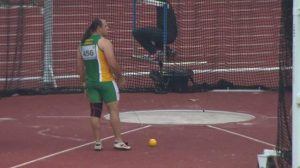
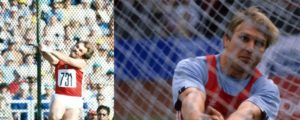
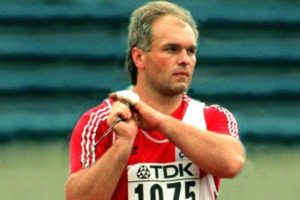
    Youri Sedykh                                                                          Chris Harmse                    

               Youri Sedykh is a Russian Hammer Thrower who achieved the world record of 86.74 meters in 1986. His record has held for 30 years to date.

 Foto 3

Youri Sedykh done 3 turns in his throwing and starts with his hammer on his right side behind him. Youri pushes the hammer out to his left and uses his power turn on his second turn. Youri also tell about how you must only start at your 0 degree which he is very good at doing. Youri has very good balance and is very stable in his technique. His heel and toe work very well together all the time. Youri also says he never would think of the finish, you just think about the turn. Youri broke most of his records on his first throw. Which I think tells you how stable he was in his technique. Youri has a saying on describing hammer throw he says, “For hammer you need rhythm, very much like waltz. Your partner hammer not human being.”

Foto 4

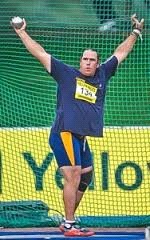
Chris Harmse is our very own South African legend. Chris has broken the African record seven times and holds the record for both the African Championships and All African Games. Chris personal best is 80.63 meters which he threw in 2005, he held it for nine years it was broken in 2014.

https://www.gettyimages.com/detail/news-photo/south-africas-chris-harmse-competes-during-the-mens-hammer-news-photo/107852884

 Chris Harmse does 4 turns in his throwing, starting on his toe in the first turn, and starts by lifting his hammer over his head. Chris has a very fast start which also makes him have a lot of speed in the circle. Chris has what he calls an active shoulder (drops the shoulder into the turn). This in turn causes you to pull / drag the hammer. His head is also not always in line with the hammer. Chris threw his personal best of 80.63 meters on his second throw. He varied a lot with all his good throws so I might say Chris is not as stable in his technique.

Foto 6                                                                                     Foto 7


Hammer Throw is quite a technical item and coaches need to remember that every athlete will develop their own technique in the basics. It’s a lot like every one’s handwriting the same letters but different style of writing.

Hammer Throw takes years and years to learn and become stable in your technique, with a lot of dedication. So if I can point out one difference in Youri Sedykh and Chris Harmse. Youri started hammer throw when he was still a little boy and Chris started a lot later in his 20’s.

My goal as a hammer throw coach is to start with younger hammer throwers at a younger age so they can develop their technique and be more stable when they get to competing age. I would like to start with children at the ages of between 10 and 12 year old, because of starting that young, I will explain to them about understand that they are not at a competing age as yet and will work a lot on technique and will put in mock competitions. I will start training with them with a broom stick, and then once they started grasping the technique of turning I will move them to a plastic hammer. When the athlete is ready then the athlete can move over to a light hammer. Each athlete will differ and progress differently. Take note that their backs are still developing at this age so no gymming. They will do running and lots of co-ordination work, i.e.: jumps, steps, kicking balls between beacons. Work out a lot of different exercises to keep them interested with games. To teach them to learn how to cope with stress, I will do mock competitions as they are still too young to compete. I will also do visualization to teach them how to relax. The most important thing is to do a lot of co-ordination work as that is the biggest problem in our children of today.

References

DVD Youri Sedykh Hammer Throwing 13 Simple Answers to 13 Hard Problems

Telecom Chris Harmse


Johnny Gray on running the 800m


One of the great 800-meter runners in U.S. history, Johnny Gray turned to coaching. He coached at the high school level and also trained U.S. 800-meter champion Khadevis Robinson.

800m 2

https://www.gettyimages.ae/detail/news-photo/frances-mahiedine-mekhissi-benabbad-competes-on-his-way-to-news-photo/453736958

What Makes a Good 800-Meter Runner?

Gray: Usually an 800-meter runner is someone who can run a fast quarter mile [400m], but isn’t fast enough to compete with the quarter-milers, and can run a pretty decent mile [1500m], but isn’t strong enough to last the whole way for the mile, so they go for the 800-meter distance.

Same thing that makes a 400-meter runner. They’re fast, but they don’t have the strength to run the 800. As for milers, they are strong but they don’t have enough speed to run the 800.

I could’ve run the quarter, the 800, the mile, or the 5K.

I could’ve done it all because I prepared my body to be able to do it all. I did trust my shape. I was a positive individual because of the experience I had throughout the two decades that I competed.

As a youngster, I chose the 800 because it was two laps. I started with the 2-mile, which was eight laps, so I was trying to be lazy when I chose the 800. But it ended up being a good move because it ended up being the race that I was able to master and do well at.

What Do You Mean by “Trust Your Shape?”

Gray: Trust your shape means don’t hold back. Keep it moving and trust that your shape will get you through. That’s what I used to do. I would go out 49,50 sek [for the first 400m], and boom, I’d pick it up again. Because I trust that I can get it done, because I know my shape is there, because I’ve been training. And the kids don’t use their shape to the fullest because of lack of faith in their conditioning.

You have kids who train hard but when it’s time to go out to the race they’re scared, they’re not able to get it done. They run that first 400 meters, but then by the third 200, they sit back and want to rest because they think, ‘OK, I’m tired, I don’t want to be too tired to kick, so I’m going to hold back so that I can have a kick.’

800m 3

The Value of Racing Experience for Coaching Others

I was lucky enough to have six chances at trying out for the Olympics. That’s why I’m so confident in what I say because everything that I’m talking about, doesn’t come out of a book. You take these coaching Level I, Level II, Level III (courses) – which is great to have, we need that. But nothing teaches you more than experience.

It feels good as a coach to be able to tell someone that if you do this, it works because I know it works, rather than reading it out of a book. If it doesn’t work then you question whether or not the book was right.

If it doesn’t work for me, I know that they didn’t do whatever they were supposed to do. Those easy days you haven’t been running. You’ve been partying at night and not resting, it’s something you’re doing off the track. So then I can call an athlete into the room and just say, ‘Hey, you know what? You’re not running what you should be running, so I’m kind of wondering what’s going on?’ And that’s when you start hearing, ‘Well, coach, I didn’t want to tell you but I’m pledging right now and I’m on line, they keep me up late every night.’ Then you start seeing what’s really going on. It’s not the training, it’s what you’re doing off the track. And that’s why I say, what you do off the track is just as important as what you do on the track.”

How Do You Train 800 Meter Runners, as Opposed to The 400 or 1500 Meters?

Gray: The 1500 and 800 are pretty much similar. But for the 1500 meters you want to do a little more mileage and a little longer intervals compared with the 800.

For 400 meter runners, you’re going to do more speed, a lot harder running, maybe more weight training for the power you need to generate to be a sprinter. So that’s the only major difference.

In any of them it takes proper preparation, it takes hard work to get it done. If you train hard and you’re a great half-miler, you should be able to run a good mile, you should be able to run a good 400. A great 800 runner should be able to run at least 46 (seconds) or faster for the 400. A great 800 runner should be able to run at least 4:05 or faster for the mile.”

800m 4

Updated January 17, 2017.


Source:   trackandfield.about.com


Hurdles: Introduction for Beginners


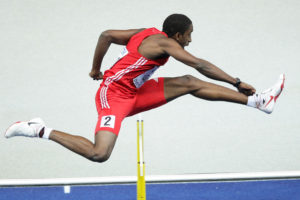
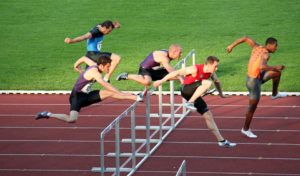
There’s a reason that the hurdles are considered running events, rather than jumping events. Reduced to simple terms, the ideal hurdler will basically run the 100 to 400 meters, while taking what amounts to a long, gliding stride over each hurdle. The competitors will spend as little time in the air as possible. They’ll get their feet back on the ground quickly after clearing each hurdle, then will continue running with consistent strides so they can clear the next obstacle just as smoothly as the last. As some coaches like to say, a hurdler event is a sprint race with a few small barriers along the way.

Laag oor die hekkies

Sport Sprint Hurdles Athlete Men Athletics

At the youth level, however, it’s a bit different. The beginning hurdler is going to run up to the hurdle, slow down, jump over the hurdle, then start running again. It almost doesn’t matter how small you make the barriers in practice. Anything reasonably close to the size of an actual hurdle is going to elicit the run-jump-run reaction

Therefore, patience on the coaches’ part is just as important as skill development on the competitors’ part when teaching the sport to new hurdles.

Safety and Comfort

As with any running event, a good stretching routine is a must. Even young, active, flexible runners will benefit from a good warm-up.

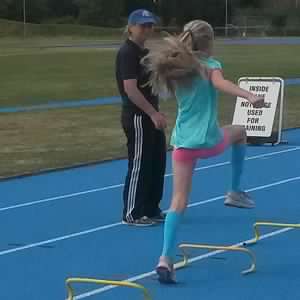
The next step is getting the runners comfortable with clearing hurdlers, and beginning to teach them to avoid the run-jump-run instinct, which can only be accomplished through repetition. While the youngsters are learning, they’ll need some barriers to clear. Youth events, depending on the competitors’ ages, generally begin with 30-inch hurdles, so beginners should start with lower barriers. Additionally, the barriers must be light and safe, so the kids won’t be injured when striking a hurdle. Options include adjustable power hurdles, which can generally be set from 6 to 42 inches high. These devices are lightweight and collapse easily when struck. Another good choice is the banana step. These training hurdles are made from lightweight plastic, colored yellow or light green – hence the “banana” in the name – and generally come in heights of 6 to 24 inches.

Klein hekkies

Technique

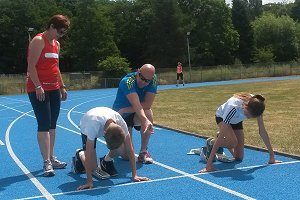
Among the teaching points for beginning hurdlers, the start will be the easiest. At higher levels, of course, races can be won or lost out of the blocks. But there’s plenty of time to work on starting technique. Novices must focus on selecting a lead hurdling leg (usually the left for right-handers), then develop a consistent stride pattern, because the stride pattern determines which leg is placed in the back of the starting blocks. If the hurdler takes an even number of steps to the first hurdle, the lead leg goes in the back block, and vice-versa for an odd number of steps.

Wegspring

Next, nothing beats repetition when you’re teaching hurdle clearance. But a little visualization never hurts. Have your prospective hurdles walk up to a youth-sized hurdle. For those who are leading with their left leg, have them walk to the right of the hurdle, lift their lead leg and stretch it out, to demonstrate that their leg can rise above the hurdle. Repeat the drill on the other side of the hurdle, but have them lift their rear leg up in proper position off to the side, with the knee as high as possible, to show that the trail leg can also pass above the hurdle without a jump. Yes, they’ll still jump the first few times, but as their comfort increases, the visualization will remain in their mind and help them progress.

HurdlesDrillsHekkie Drils

Start the novices out clearing just one practice barrier, but make sure they sprint to a finish line after clearing it, to get used to the rhythm of a hurdles race. Many races, after all, are won between the final hurdle and the tape. Next, add the second hurdle, so the competitors can begin developing a stride pattern between hurdles. Again, repetition is the best teacher. As the athlete’s progress, gradually increase the height of the practice barriers, and increase their number. At some levels, youth hurdlers will face eight barriers, moving up to a maximum of 10.

Conclusion

Don’t worry about the fine points at the beginning. Just get the hurdlers comfortable clearing the barriers without jumping, while developing a reasonably consistent stride pattern. As they improve, begin to emphasize proper clearance techniques, with the lead leg snapping up, the upper body leaning forward, and the trial leg rising up and to the side, with the knee higher than the foot.

By Mike Rosenbaum

Source: trackandfield.about.com