Why do sprinters fall apart at the end of a race?


By Latif Thomas, Complete Track and Field

Recently, I had the distinct pleasure of attending a 6 hour freshman/sophomore meet. The meet was very well run, it was just, you know, a 6 hour freshman/sophomore meet. I can’t tell you how many times I watched sprinters fall apart at the end of races.
First of all, no. its not because of a lack of “conditioning”.
It is a coaching mistake to assume that, when sprinters get run down in races, the solution is more ‘conditioning’, whatever that means. And, yes, that applies to 400m training programs as well.
I didn’t invent these ideas. I learned them when I was preparing to teach the sprints and relays sections of the USTFCCCA Track & Field Technical Certification.
I thought it was a great way of thinking about how you should view your program design, or, perhaps more appropriately, view the ‘holes’ in your program design. After all, coaching high school sprinters is a wildly different animal than coaching in the collegiate environment.
Coaching success means starting with the end in mind. Without a clear understanding of how to design and implement an effective annual plan for sprinters, you’re doomed to making well intentioned, but false assumptions about why your sprinters fail to execute and perform.
So, again, there are only THREE reasons sprinters fall apart at the end of races.
As the coach, it is up to you to understand these reasons in order to consistently identify and fix the fatal technical flaws frustrating both you and your sprints squad. This article will help you figure out where and why things are going wrong, as well as how to fix the problem/s.

1. Energy System Failure
When coaches fail to adequately develop the anaerobic energy system, athletes often decelerate rapidly at the end of their race. This is frequently the cause in the 400, occasionally the cause in the 200 and never the cause in the 100.
In a nutshell, when coaches do too much aerobic and interval work and not enough acceleration (high intensity runs of 2-4 seconds), top end speed/maximum velocity (high intensity runs of 4-8 seconds), speed endurance (high intensity runs of 8-15 seconds), special endurance (high intensity runs of 20 seconds to 2 minutes), strength and power, (multi jumps, and multi throws) development, sprinters fail to develop the qualities required to be successful in the sprint events.
We can debate the split with 400 types. And, no doubt, you’ve watched your 400 runners tie up over the last 150 meters on multiple occasions. Your mind will tell you, “They need more ‘strength'”. If you do the math, you may find they simply don’t have the flat out speed to match top 400m specialists. Therefore, especially at the HS level, they don’t need more high volume, low intensity interval days. They need more work near, at or faster than race pace.
2. Coordination Erosion
After operating at top speeds for more than a few seconds, the body’s motor control systems tend to fail.
The ability to coordinate efficient movement patterns falls apart and then, if you know what you’re looking at, your sprinters are just stumbling and bumbling down the track, trying not to fall down. We see this most often toward the end of shorter sprint events.
If I were to break down the goals of my entire training philosophy and system, all into one sentence (after injury prevention) it would be:
Everything we do revolves around developing general and specific coordination.  Even our skipping is done in a very specific way:
Upright posture (chin up, chest up, toe up, knee up, heel up) and *flat* footed landing with the shin perpendicular to the ground at foot strike. If we let kids get away with toe or heel first landings, even during the warm up, it contributes to the insufficient motor patterns we’re working so hard to fix.
If coordination development isn’t a foundational part of your program, your sprinters probably get run down at the end of races, particularly against skilled sprinters with slightly less or equal levels of ability.
3. Momentum Deprivation
That’s a fancy term for having an ineffective ‘drive phase’. Your sprinters simply don’t push hard enough for long enough.
In truth, the problems start with their starting blocks settings. Most young sprinters are not properly situated in the blocks before the gun goes off.
Once the starting gun goes off, most inexperienced sprinters react like a sleeping cat when you slam two pans behind their head: Wild eyed, panicked and paying no particular attention to anything other than getting out of there as quickly as possible.
They might perform old school speed drills like Champions in practice. But when the gun goes off they immediately revert to whatever feels most natural.
Unfortunately, what feels natural is not fast. So they pick their head up, flick the drive arm up about 4 inches, step out of the blocks, stand straight up and start spinning their wheels like they’re auditioning to be the Road Runner. And we all know what happens to the Road Runner.
It’s sad really. Also, not fast.
So when they come out of blocks and shift gears too quickly or do some weird, seizure-like variation of the drive phase mechanics you were hoping for, it leads to not reaching their true top speed, getting to that fake top speed too early and beginning deceleration too soon.
In fact, you might consider holding your sprinters out of blocks until they show the ability to do quality down (3 point, 4 point) starts without blocks. Regardless of whether you adopt this approach, they still need to get set up properly in the down position if they’re going to develop any consistency, especially in the chaos of an actual race!
This is why we do some form of acceleration development every day. Yes, every day. Starting the first day of practice.
You just have to patient because unless you have naturally explosive and/or extremely strong athletes who can hack their way to fast 100m times day one, your kids will probably have to take a step back before taking two steps forward.
So, in summary, your athletes must possess the ability to express large amounts of strength and power for the duration of their race.
They need the general and specific coordination to execute a consistent, efficient and violent drive phase that transitions into consistent and efficient coordination of top end speed and speed maintenance mechanics.
And they need enough reps in practice at appropriate velocities and intensities to allow them to execute these skills in competitive situations.
The extent to which they develop these skills and qualities is directly proportional to how well you implement a training program addressing the workouts, volumes and intensities scientifically proven to generate faster times.
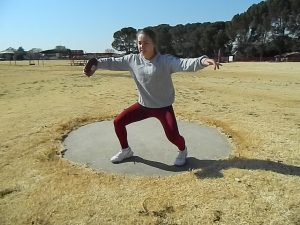
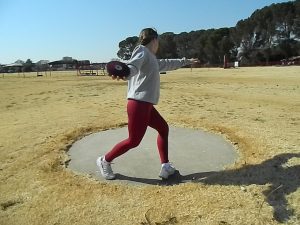
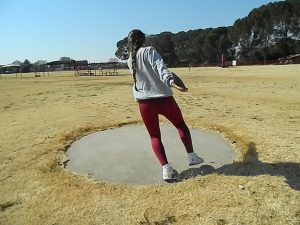
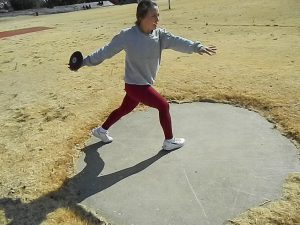
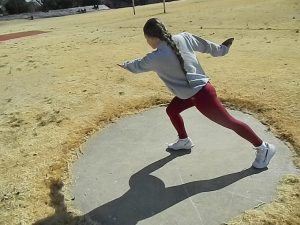
Diskus: Die draai


Deur Rudolph Cloete. VSAAV Vlak III, ASA Vlak III

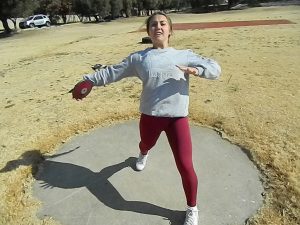
Alhoewel die diskus, wat uit ‘n stilstaande posisie afgelewer word, ‘n geldige poging in ‘n kompetisie is, is dit nie ‘n idiale situasie nie. Die draai in die sirkel verleen momentum aan die implement en sorg gewoonlik vir ‘n beter afstand. Jong, onervare atlete, wat nog die tegniek ten volle moet bemeester, maak gebruik van die halwe draai. Dit gee ook ‘n beter afstand as wat die stilstaande poging sal gee! Maar die mikpunt is om die atleet te leer om die volle draai in die sirkel te bemeester.

Foto 1

Die atleet gaan staan met sy rug na die landingsarea. ‘n Senior seun sal die volle sirkel wil benut en daarom sal hy teenaan die agterste sirkelrand stelling inneem. Die meisieatleet sal ‘n bietjie weg van die sirkelrand staan soos in hierdie foto gesien kan word – in albei gevalle wil die atlete, nadat die draai voltooi is, so naby as moontlik aan die voorste sirkelrand eindig.   Bene lekker uitmekaar vir balans en die liggaam ontspanne. As die diskus geswaai word, wissel die liggaamsgewig van die regtervoet na die linkervoet. Die diskus is 90 grade agter die skouerlyn.

Foto 2

Sodra die draai-aksie begin, word die bene gebuig en die liggaamsgewig na die linkerbeen verplaas. Die liggaam val na links. Die linkervoet maak oop sodat die liggaam om daardie been kan roteer. Die diskus bly nog steeds agter, arm gestrek. Die regterbeen moet so lank moontlik op die grond bly.

Foto 3

Sodra die liggaam ver na links gedraai het, verlaat die regterbeen die grond en swaai dit wyd en aktief om die linkerbeen. Die linkerbeen dryf nou die atleet se liggaam oor die sirkel. Die atleet se lyf lê nog steeds na links en voorentoe. Die regterarm, met implement, is nog steeds na agter gestrek.

Foto 4

Die linkerbeen het nou die liggaam oor die sirkel gedryf sodat die regtervoet oor die helfte van die sirkel land. Baie boeke praat van “a run across” – hardloop oor die sirkel! Nou maak die atleet gereed om om die regterbeen te draai en die linkerbeen so naby as moontlik aan die voorste sirkelrand te plaas.

Foto 5

Nadat die linkerbeen om die regterbeen geroteer het, word dit ver uitgestrek om so na as moontlik aan die voorste sirkelrand te kom. Die strekbeweging maak dat die atleet se lyf nou na agter lê, reg om oor die linkerbeen te beweeg in die afleweringsfase in!

Foto 6

Die liggaam roteer om sy as en beweeg na die linkerbeen toe. Die regterbeen dryf die atleet se heupe na vore. Die regterarm, met implement, kom nou kragtig deur en swaai met ‘n reguit arm saam met die roterende krag voorentoe. Die arm kom van laer as die skouer deur. Let op na die oopmaak van die bolyf in die foto. Die linkerarm word kragtig na agter en af met ‘n kort-armaksie gedryf – ook dit help die regterarm om kragtig deur te kom. Die atleet swaai nou die diskus van onder die skouerlyn en beweeg dit na ‘n hoë punt, waar die implement gelos word.

NB: Die foto’s wys hoe die tegniek stap vir stap gedoen moet word – maar in werklikheid

is die beweging aaneenlopend en werk van stadig tot baie vining waar die diskus gelos word.

Demonstrand:  Mieke van Vuuren

Bronne:

Ecker, Tom and Wilt, Fred. Illustrated guide to Olympic track and field techniques. Faber and Faber, 24 Russell Square, Londen.

SA Suiker Nasionale  Atletiekafrigterssimposium, 1987, No. 6


DRIESPRONG: Die drie fases van die sprong


Deur Rudolph Cloete, VSAAV Vlak III

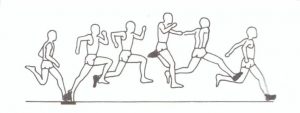
Die Driesprong bestaan werklik uit drie spronge wat tussen die vastrapplank en die put gemaak moet word! Dit is die hink/”hop”, stap/”step” en sprong/”jump”.

Die aanloop:

Die Driesprongaanloop en die Verspringaanloop is presies dieselfde: dieselfde lengte, dieselfde spoed en dieselfde tegniek in die versnelling.

Die vastrap/aftrap

Die Driesprong se vastrap/aftrap verskil heeltemal van die van die Verspring! In Verspring maak die atleet gereed om hoogte vanaf die vastrapplank te kry. Dus is sy vastrap hard op die plank en sy opswaaibeen word tot bokant horisontaal, kragtig opgeswaai!

Die driespronger hardloop oor die plank en trap minder hard op die plank. Die opswaaiknieg beweeg slegs tot op die horisontaal. Dus dryf die driespronger voorentoe en nie op vir hoogte nie!

Die hink/”hop”

2020-04-04_060802

Die hink is die laagste van die drie fases, want dit het nog volop sproed om mee te werk. Die vastrapbeen buig en kom onder die sitvlak deur en roteer totdat daar weer op dit geland word. Die bolyf bly neutral en regop – arms roteer saam met been.

Die hink moet 30% van die totale sprong uitmaak.

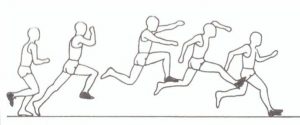
Die stap/”step”

2020-04-04_060955

Dit is die moeilikste deel van Driesprong! Dis hier waar die kaf van die koring geskei word.

Die Stap moet gespring word en nie gehardloop word nie. Die beginneratleet is geneig om dit te hardloop en himself so voor te berei om die derde fase, nl. die sprong, lekker ver te maak. Die probleem is dat ‘n hardlooptreë nooit so lank soos ‘n spingtreë sal wees nie EN hierdie fase moet 30% van die totale sprong uitmaak.

In die Stap word die vrybeen kragtig deurgeswaai en op horisontaal geblok. Die posisie word gehandhaaf totdat die voorwaardse momentum so afgeneem het dat die vrybeen se voet op die grond gesit kan word. Bolyf by neutral en regop. Arms swaai gesinkroniseerd met die been.

Die Stapfase is hoër as die sprongfase, want die atleet se voorwaarde spoed het afgeneem.

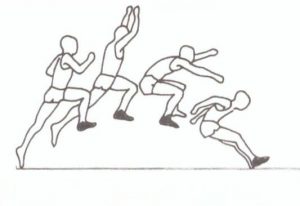
Die sprong/”jump”

2020-04-04_061145

In die Spong word daar, net soos in Verspring, na die die hoogste moontlike liggaamsposisie gestrewe…die hoogste, want in hierdie fase is al die spoed waarmee die atleet begin het, amper opgebruik! Die atleet moet hard werk, want hy spring van sy swakbeen af, tog moet hierdie fase 35% van die totale sprong uitmaak.

Die meeste atlete gebruik die seilmetode van verspring: dus word die bene saam opgeswaai en die atleet trek in ‘n sittende posisie op pad na die landing.

Sprongverhoudings

Soos hierbo gesê, is die strewe ‘n 35% – 30% -35% verhouding. Dit is die ideal, maar in die praltyk sal dit van die atleet se fisiese eienskappe en kragvermoeë afhang:

As hy vining is, sal die verhouding eerder 40% -33% -27% wees!

Meisies spring amper ook so ‘n verhouding 43% -32% – 26%

Sterk seuns, maar bietjie stadiger, kom gewoonlik nader aan die optimum!

Bronne: 

1.  U.Jonath/E.Haag/R.Krempel, Atletiek, training, techniek,taktiek., Elmar Sport, 1977

  1. Bullard, L. Knuth, Triple Jump Encyclopedia. The Athletic Press, Pasadena, California, 1977


Improving the speed performance of a short distance athlete


Written by Amiskha Hattingh, Level III coach, VSAAV

There are several contradictions in the history of sprinting regarding the development and improvement of an athletes’ speed. This emphasise the believe that sprinters are born and not created (Douglas 2014). However, Seana (2016) argue that each athlete has a different type of muscle fiber compiled within their muscles. Athletes that have more fast-twitching muscles are more capable of sprinting, while athletes with more slow twitching muscles are better performers over longer distances. In addition, an athletes’ specific muscle type can be trained and regulated through specialised conditioning according to their muscle fibre. As such, fast-twitch fibers can be improved with sprints, weight preparation, and high intensity interval training, where long distance running will assist in developing slow-twitch muscles. Contrastingly, fast-twitch muscles also use less energy, given that it is more explosive, nevertheless, these muscles get tired quicker. Sauer (2018) state that genetic factors such as the size, body composition, mitochondria, and the fiber type of an athlete is heritable, and can therefore only be adapted and not changed.

Rautenbach (2019) further strengthen the fact that athletes can improve their speed performance through practising and developing accurate technique, physiological conditioning, strength training, as well as psychological preparation and planning. Therefore, the athlete that is the “quickest” does not automatically win the race. Contrastingly, the athlete who runs the furthest within the same time, while obtaining optimum speed have a higher chance of winning the race. This statement is supported with Usian Bolt’s world record of 9.58 seconds on the 100 meter sprint, where he kept his maximum speed for less than 20 meters.

Stander (2017) highlight several aspects that need to be taken into consideration to develop an athletes’ speed. This includes faster leg movement of the athlete, where leg speed can be improved, but according to a marginal tempo. Athletes’ stride length should be increased and maintained throughout the race. This technique requires a great deal of conditioning due to the fact that it is not a natural way of running. Therefore, the increasing of stride lengths improves the speed of an athlete dramatically. Speed can also be developed through sustaining top speed over a longer period of time. In addition, practise sessions that include speed endurance can also lead to improvement of an athletes’ sprinting time, but it is not recommended as a natural way of running. As such, strength and conditioning during several practise sessions is crucial to enable the athlete to efficiently complete these unnatural ways of running.

Another way to improve an athletes’ running speed is to focus on eccentric and isometric exercises. This implies that an athletes’ hamstring does not just act as knee flexors, but they also serve as a support system that keeps the knee joint stable while the force conveys from the hips. Therefore, strong hamstrings assist the glutes with hip extension and subsequently slows the knee extension down during the swing phase, which will ultimately lead to improved running speed. Furthermore, the effective use of an athletes’ arms serves as a vital factor to improve their running speed. It is recommended that athletes’ elbows are kept at 90 degrees, where each hand must be brought up in front of their face. In addition, the athletes body must not bend forward along with sagging shoulders, given that it will slow the athlete down (Sacks, 2015).

In order to increase an athletes speed performance, their explosive power needs to be trained and maintained effectively. Therefore, several repetitions of explosive movements must be practised to keep the athletes’ running form in shape. Different exercises can be done to develop an athletes’ speed; such as knee pick-ups where their knees are raised up until their waist within a short distance of 10 meters. The athletes’ main focus should be on their arms and elbows, where their elbows should be held at a 90-degree angle, as well as keeping their arms tension free. This exercise will also pressure the athlete to make as many ground contacts as they can.

Tuck jump exercises also assist athletes to develop speed. As such, athletes’ need to squat down, followed with straight high jumps. The athletes’ knees must be lifted up to their chest, where their landing must be shuttle and soft on their feet. Moreover, rocket jumps also improve the running speed of athletes. This exercise incorporates squatting, where the athlete explodes into the air with their body kept in a straight position and their arms stretched out above their head.

Skips can also increase an athletes’ sprinting speed. The athlete should try to lift their feet as high as possible through using their arms to assist their bodies on the high jumps. This exercise can be adapted, where athletes can skip over a specific distance. Therefore, athletes should attempt to skip as far as they can with each skip. This workout can be done over 30 meters (Stirner, 2019).

Again, Stander (2017) emphasise exercises that can be done in order to develop a good running technique, that will ultimately lead to the athletes’ development of speed. As such, athletes’ can practise high knees. Here the athlete jogs while they lift their knees high and move their feet downwards in a fast and straight position. The reach exercise can also be practised to generate speed. Therefore, the athlete must practise the exaggeration of each foreleg in a downfield position on the grass and not on the track.

Another method of developing speed within an athlete, is the running high on their toes exercise. Additionally, athletes must appear in a “tall” position, while they rise as high as possible on the ball of their feet. The athletes must then run on the definite spot that they are standing on, lean forwards from their heels, and then run down field staying high on the ball of their feet.

As such, the arm reach exercise can also be an effective approach to generate speed. The athlete must try and exaggerate their arm reach without attempting to run faster. The lead arm must be kept low while the athlete reaches forward. This technique will allow the athlete to run faster without any extra physical effort. Also, taking into consideration that the athletes’ hand and trail arm must not be lifted higher than their hips.

An alternative technique that can be incorporated is where the athlete must bound forward. This implies that athletes must bound forward and not upward, where they run down to the field in order for their head to maintain a straight position. The athlete must concentrate to always have one foot on their ground while they push against the ground with force. If the athlete jumps upwards, both their feet will be in the air, and it will be easy to assess any faults that the athlete makes.

In addition, athletes can incorporate the bounce exercise, where they have to lock their knees and bound forward through flipping their ankles. Athletes’ can also include the lean exercise within their training sessions. Here the athlete must stand with both of their feet together and lean forward from them heals which is about 30 degrees from a vertical angle. This lean must be sustained while the athlete strides downwards on the field.

In order to develop speed, athletes can make use of the run tall exercise. In addition, the athlete must put their hands against a wall, and back up as far as they can with their heels still on the ground. Thereafter, the athlete must rise on their toes while they lift their leading knee. It is crucial that the heel, hip and knee must stay in line at all given times.

Lastly, a relaxation exercise can be done in order to develop a good technique that will result in development of speed performance. The athlete must run with a total of 90 percent effort over 30 to 50 meters. Here the athlete must try to stay as relaxed as possible, while they run with an excessively loose jaw and relaxed hands. The emphasis is placed on the fact that the training of this technique must be free of effort.

Coultman (2018) identified several factors that sprinters should keep in mind when running, that will subsequently have an effect on the athletes’ speed performance. As such, athletes must try to keep their head in line with their spine, while they focus their eyesight directly down the track. The jaw and neck muscles of athletes should be relaxed at all times. Athletes’ should also stray from clenching on their teeth. In addition, athletes’ shoulders should not be raised up to their ear lopes, but rather be kept low and relaxed. Additionally, athletes should run with open palms, while their arms and legs correspond with each other. Athletes should also ensure that any extensions and flexing of their hip does not take place, due to the fact that it will limit the athletes’ range of motion. Another factor that is crucial in order to ensure an effective sprint, is that athletes should run on the ball of their feet and push forward with their toes. As such, athletes should maintain a long and comfortable stride, given that over striding of the legs will result in less power to use, and also stress and un-comfortability on the hamstrings of the athlete.

Genders (2016) also emphasise different types of running workouts in order to increase an athletes’ speed. Therefore, hills can be incorporated within training sessions, where it improves endurance with minimum muscle stress and elevate an effective running form. Another exercise that can be incorporated is fartleks. Fartleks are a Swedish word for speed play. This implies that the athlete will learn to run faster, combined with slower recovery jogs, and short rest intervals. Furthermore, interval training also assists athletes to run at a specific speed and a pre-set distance, as well as a specific recovery/rest period. This all depends on the fitness of the athlete. Because of the fact that an athletes sprinting form worsen approximately 75 percent into their race. As such, athletes need to be taught to maintain their sprint for 25 meters before the finish line. At this stage, athletes must develop a conditioned reflex, where they lift their knees higher, work harder with their arms, get on their toes into a tall running action, staying loose with their jaws and hands still relaxed, as well as focusing their eyes on the finish line, without looking around them.

To conclude, it is not natural for any athlete to run with high knees, on their toes, pushing explosively while running, or to work vigorously with their arms. Therefore, enough strength and conditioning is paramount within any sprinters workout. The abovementioned sprinting exercises must be done on a regular basis, in order for the athlete to adapt these exercises as a habit (Stander, 2017).

BIBLIOGRAPHY

Coultman, L. 2018. Sprinting technique: They key to increasing your speed. https://trackandfieldnews.com/track-coach/sprinting-technique-the-key-to-increasing-your-speed/ Date of access: 31 July 2019.

Douglas, S. 2014. Sprinters are born, not made. Runner’s world. https://www.runnersworld.com/races-places/a20794324/sprinters-are-born-not-made/ Date of access: 29 July 2019.

Genders, L. 2016. Types of running workouts to increase speed. https://www.leagendersfitness.com Date of access: 31 July 2019.

Rautenbach, S. 2019. Sprints, hurdles and relays. Basic coaching manual. Athletics.org.za. http://athletics.org.za/wp-content/uploads/2017/08/ASA-Level-1-Coaching-Sprints-Hurdles-Relays.pdf Date of access: 29 July 2019.

Sacks, A. 2015. Five easy ways to improve your sprint speed. https://www.stack.com/a/improve-sprint-speed Date of access: 30 July 2019.

Sauer, C. 2018. Are sprinters really born and not made? What if this is like when people thought it was impossible to run a mile sub 4 min? Maybe slower sprinters are not given attention and never get the chance to really improve. https://www.quora.com/Are-sprinters-really-born-and-not-made-What-if-this-is-like-when-people-thought-it-was-impossible-to-run-a-mile-sub-4-min-Maybe-slower-sprinters-are-not-given-attention-and-never-get-the-chance-to-really-improve Date of access: 29 July 2019.

Seana. 2016. Increasing speed: Is it all genetics? Freeletics.com. https://www.freeletics.com/en/blog/posts/increasing-speed-is-it-all-genetics/ Date of access: 29 July 2019.

Stander, R. 2017. Athletics omnibus-sprints- Athletics South Africa. http://athletics.org.za/wp-content/uploads/2017/08/Coaching-Sprints.pdf Date of access: 31 July 2019.


Coaching the Generation Z-athlete


This article is an extract from an article by Dr. Celesti Jansen van Rensburg which was written for the Free State Academy of Sport. Comments are added by Rudolph Cloete.

Coaches must know the athletes who they work with! The problem is that there is usually a big generation gap between coaches and the athletes. Therefore, the coach  must take into consideration what makes his athletes tick!!

Different generation has different characteristics! Working with school athletes means that the coach is working with the so called Generation Z (born after 1996) – while he/she falls into the category of Generation X or Millennial!

Characteristics of Generation Z:

More practical – less theoretical

Show, don’t tell

Open-minded, but impatient

Creative and Innovative

Up for a challenge

Happiness is very important

Friends are very important

More face to face communication

More global in their thinking

Less structured education preferences – use alternative methods

More individualistic

More technology dependant

More parented – they have “helicopter parents”

More early starts – in work, sport, education

More disruptive – they are multitaskers

Very short attention span

More entrepreneurial

Personal responsibility is high in some

Outcomes focused

Mentor seeking – don’t care for academics

Difference makers – 60% of them wants to make a difference

Some comments for coaches on these characteristics:

  1. Make use of technology: cellphone video clips and YouTube etc. Take video clips of their technique and show it to them when explaining something.
  2. Work individually with each athlete when explaining something important. Don’t explain important things to the whole group of athletes. They prefer  that the coach pull them to the side when he/she wants to explain their mistakes.
  3. Keep explanations short. Get to the point.
  4. Don’t give 3 or 4 orders simultaneously.
  5. Set realistic goals – they strive on positive outcomes.
  6. Be creative in your training schedule – change and mix up the exercises on a regular basis. Don’t let them become bored.
  7. Don’t yell! The Generation Z-athlete will take this as a sigh that the coach is angry at him/her!  They want the coach too consistently remain calm and in control of himself!
  8. Be aware of your gestures – the athlete may interpret it as a negative attitude towards them/him/her. They prefer a coach who shows positive interaction and feedback.

Coaches must change the way they think about and deliver the information he/she wants the athletes to hear.

Challenges coaches are facing:

  1. Athletes and parents who think they have a free pass to act disrespectfully because they are paying the coach.
  2. Athletes and parents who think they have a complete monopoly on coaches’ time (even personal time).
  3. Athletes and parents who want to blame a lack of progress on the coach, instead of looking at themselves or their potential.
  4. Parents who interfere with the coaches’ methods and/or program.

A negative  experience  with a coach is likely to have a greater impact on the coach-athlete relationship; hindering the positive youth sport experience


Op 6 Julie 2019 voel Rooimier dat dit tyd is om iets oor Caster Semenya te sê


Caster Semenya is al van skooldae af ‘n uitstaande atleet in die middelafstande! Deesdae is sy verseker SA se steratleet! As die 2009 Wêrelkampioen in die 800m, as die 2016 Olimpiese Spelekampioen in die 800m en toe weer in 2017 die Wêreldkampioen in die 800m,  is dit veilig om te sê dat SA nog nooit haar gelyke op die atletiekbaan gesien het nie!

Ongelukkig is Semenya nie net bekend vir haar atletiekprestasies nie, sy is ook die simbool vir damesatlete met ‘n verhoogde testostoroonvlakke – en sy is nie die enigste vroue-atleet in atletiek wat aan die toestand ly nie. Vir van u wat nie weet wat testostoroon is nie, net die volgende: dit is die primêre manlike sekshormoon en ‘n anaboliese steriode. Dit gee spier- en beenmassa aan die atleet.

So, ja, vroue-atlete wat aan die toestand ly, het ‘n voordeel wanneer dit by fisieke prestasies kom! MAAR aan die ander kant – en iets wat soms uit die oog verloor word – is dat atlete soos Semenya niks gedoen het om haarself hierdie voordeel te “gegee” het nie…sy is so gebore! En tog is sy ‘n vrou! Dus is sy ‘n vrou, wat gebore is met verhoogde manlike hormone. Sy het geen skuld hieraan nie!

Nou stamp sy koppe met die Wêreld Atletiekliggaam (voorheen bekend as die IAAF). Die wil hê dat Semenya medisyne moet drink om haar testostoroonvlakke af te bring tot by ‘n meer aanvaarbare vlak. (Onthou dat alle vrou wel oor testostoroon beskik, net in baie kleiner hoeveelhede as Semenya) Nou word sy “gestraf”, maar sy het nie skuld nie! Ook weet ons nie regtig wat die onbedoelde gevolge vir Semenya se gesondheid sal wees as haar hormoonvlakke kunsmatig verlaag word nie!!

…en hierin lê die dilemma: Caster is nie “siek” nie! Hoe kan sy gedwing word om medisyne te gebruik omdat sy aan ‘n natuurlike toestand ly?! MAAR aan die ander kant: sy het wel ‘n voorsprong op die ander vroue-atlete op die atletiekbaan! Dit is Wêreld Atletiek se mandaat om die speelveld vir almal gelyk te maak – hulle wil die ander vroue-atlete beskerm. Dus moet Semenya haar testostoroonvlakke of afbring of ophou met atletiek Of minstens in ‘n ander atletiekitem, waar haar voorsprong nie so sterk is nie, meeding!

“She is between a rock and a hard place” Rooimier kry haar jammer!


Strategy for the 400m-race


by Mike Rosenbaum , Updated May 25, 2018

The following advice on running the 400 meters is based on a presentation by Harvey Glance, a 1976 Olympic 4 x 100-meter gold medalist and long-time track and field coach. Glance has coached for colleges such as Auburn and Alabama, was the U.S. National Team coach at the 2009 World Championships, and as of 2016 was the personal coach of Olympic 400-meter champion Kirani James. Glance gave his 400-meter presentation at the 2015 Michigan Interscholastic Track Coaches Association’s coaching clinic.

The 400 Meters Is Classified as a Sprint Race

Even world-class 400-meter runners, however, cannot sprint all-out for 400 meters; it’s not humanly possible. The question, therefore, is when should a 400-meter runner sprint at full speed, and when should the runner ease up a bit? According to Harvey Glance, the key is to break the race up into 100-meter segments, with the initial segment setting the tone for the remainder of the race.

Glance, who was primarily and 100- and 200-meter runner, but who also competed in the 400, calls the one-lap event “one of the toughest races there is to master,” adding, “the big difference in the 400 meters is the fact that you’ve got to break it down to (learn) how to run this particular race. You can’t go out too fast. If you go out too fast, you’re going to pay for it in the end. You can’t go out too slow, or you’re going to be behind and you’ll have to catch up. So what we try to do in running 400 meters, is kind of break it down into sections. Whether you’re in high school, whether you’re in junior college, or whether you’re in college or at a world-class level – run each 100 meters in sections.”

How Kirani James Runs the 400 Meters

Glance’s 400-meter philosophy, in brief, is to run hard out of the blocks and then continue sprinting strongly through the 200-meter mark. The runner can then ease back a bit for the next 100 meters before surging back to full speed for the final 100. To illustrate his point, he described how he’s helped James prepare for major international competitions, in terms of workout and race strategy.

“When we go to a track meet, and we’re running against LaShawn Merritt,” Glance says, “over a two-week period I’ll give (James) workouts to break down each and every aspect of that particular race. I want him to come through the first 100 meters in around 10.9 or 11 seconds. I want to get out of the blocks and be aggressive. So I’ll give him maybe six 100-meter (workout repetitions) of 11 seconds (each). At the time I say ‘go’ and the time he hits 100 meters, there’ll be a whistle. And I’ll put a little hurdle up, at the 100-meter mark – if he’s behind that mark (after 11 seconds), he knows to pick it up. If he’s passed that mark, he knows to slow it down. So we give him, in his mind, a little tempo of where we expect him to be at a certain point, at the first 100 meters. Unless you train your athlete to have that rhythm in their mind and their body, then it’s hard to achieve.

“When we go to 200 meters … I always say to him, ‘I want you to come through the 200 meters, at a major championship, or in the Diamond League, in 21.1 or 21.2.’ That’s for him – he’s a 43.7 (runner). And how do we do that? I don’t worry about running 200 meters in practice at 21 seconds. I only worry about the first 100 meters. Once he comes through 100 meters in 11 seconds, he now knows to keep building or to maintain (his speed). I don’t have to see it in practice; I don’t have to give him six 200s in 21.2. That first 100 is good because that creates the rhythm. Once you create a rhythm you should be able to maintain that rhythm and motion, of what he’s trying to do. He knows if he has to go down another gear (after 100 meters) then he’s too fast. He knows if he’s behind that mark, he’s got to pick it up. So we establish the 400-meter (strategy) in the first 100 meters.”

Glance also notes that 400-meter world record-holder Michael Johnson approached the event in the same way.

Johnson, Glance explains, “basically did what Kirani does in the first 200 meters – he’d come through in about 21.1, 21.2. And Michael would relax pretty much the next 100 meters. He’d reserve (some energy). He did the first 200 meters in about 21.2, 21.1, then he’d back off and try to just glide the next 100 meters, and then he’d take off again the last 100.”

The 400 Meters for Younger Runners

Translating his philosophy to a hypothetical, younger, 400-meter athlete – for example, a high school girl who runs the 400 in about 58 seconds – Glance warns coaches not to expect even splits in each 100-meter segment.

“If she is a 58-second 400-meter runner,” Glance says, “14 or 15 (seconds) per 100 meters on the front end isn’t bad. It’s going to set you up for what you’ve got to do. But you’ve got to understand, you’re not going to get 14 at the end of a race (i.e., the last 100 meters) if she’s a 58-second runner. So you may want to go 16 or 17 for the first 100 meters, and then you build on that. So you say, ‘Relax down the straightaway – keep it going.’ Then you’re in position for where you want to be.”

In his athletic and coaching career, Glance adds, he’s seen 400-meter runners who were capable of running in the mid-44-second range, who would qualify for a major event and then run a second or more slower than their personal bests because they believed they had to change their style when facing the best runners. Instead, Glance advises 400-meter runners at all levels to develop a solid race plan, and then stick to it. “The great ones run the same, each and every time. And they put themselves in position to compete for titles.”

When competing at a relatively high level – whether it’s for an Olympic medal, or for state or local championships – Glance advises 400-meter runners “to still be poised enough to execute what you’ve practiced. The first 100 meters of a 400-meter race sets up everything. The rhythm, staying in the race, having something left at the end of the race – it’s about execution.”


Spiesgooi: Die aanloop


Die aanloop van die spiesgooi-atleet.

deur Ané van Rooyen, VSAAV VlakIII

Belangrike punte om te onthou:

Die aanloop

  • Die aanloop moet ritmies en ontspanne wees.
  • ‘n Goeie hardloopaksie is deurgaans noodsaaklik (skouer, heupe en voete na vore).
  • Die aanloop moet in spoed opbou van stadig na vinning.
  • Die aanloop moet teen maksimum beheerbare spoed uitgevoer word.
  • Die greep moet ontspanne wees.

Die begin van die aanloop:

Daar is 3 maniere hoe die atleet sy aanloop kan begin, nl.Staan met voete langs mekaar.

  1. Staan met voete langsmekaar
  2. Staan met regtervoet voor (indien linkshandig, staan jy met linkervoet voor)
  3. Die atleet kan ook inloop na die beginmerk toe, die atleet moet hier net verseker dat hulle met die regte voet hulle aanloop gaan begin.

Lengte van die aanloop:

Die lengte van die aanloop sal verskil van atleet tot atleet. Die beginneratleet se aanloop kan uit 4 hardlooppasse bestaan en uit 5 oorskakelingspasse, waar die meer gevorderde atleet/   senioratleet se aanloop uit 8 hardlooppasse en 5 oorskakelingspasse kan bestaan.

Hier onder is voorbeelde van die aanloop en verskillende kombinasies:

  • 8 Hardlooppasse         +          5 oorskakelingspasse = 13 passe                                   (Begin met regtervoet voor)
  • 8 Hardlooppasse         +          6 oorskakelingspasse = 14 passe                                    (Begin met linkervoet voor)
  • 8 Hardlooppasse         +          7 oorskakelingspasse = 15 passé                                    (Begin met regtervoet voor)

Die atleet moet n aanloop kry wat vir hom/haar gemaklik is, en dat die aksie op ‘n gemaklike en vloeiende wyse uitgevoer word . Die atleet se aanloop gaan die hele seisoen dieselfde bly. Die hardloopafstand kan dalk langer word aangesien die atleet se spoedvaardighede gaan verbeter. Die aanloopafstand hang ook af van die soort oppervlak waarop die atleet deelneem.

Daar is 5 verskillende fases in die aanloop van spiesgooi:

Die dra van die spies

Spiesgooi 1

  1. Die gooiarm moet ontspanne wees tydens die aanloop. Die gooiarm word bokant die kop gehou met die arm wat 90° sywaarts wys. Die spies word dan kophoogte gedra met die punt wat oor die linkeroog geplaas word met die punt wat afwaarts wys. Die spies word of met n afwaartse punt of parallel bo die kop gedra. Die aanloop word gebruik om liggaamsmomentum en spiermomentum op te bou (massa x snelheid = momentum). Spiesgooiers moet poog om hul aanloop in passe van 4 in te deel. Dit help die gooier om n ritmiese aanloop te verkry.

Die terugtrek van die spies

Spiesgooi 2

  1. Die terugtrek van die spies vind na die hardlooppasse plaas. Wanneer die atleet se regtervoet by die kontrolemerk kom. word die spies oor 2 passe teruggetrek. Die terugtrek van die spies is ‘n vloeiende aksie (die atleet beweeg onder die spies uit). Met die terugtrek moet die arm atleties gestrek wees en die handpalm na bo en ingedraai wees. Die spies moet in die terugtrekposissie tussen die oog en kophoogte gedra word. Die atleet moet in die terugtrekpasse versnel om meer momentum agter die spies te verkry.

Die impulspas

Spiesgooi 3

  1. Die voorlaaste pas (impulspas) is n vinnige beweging. Daar word altyd gesê dat die atleet die linkerbeen (indien atleet regs is) die grond na hom toe moet aantrek om oor die been te gaan na die aflewering van die spies. Met die impulspas land die gooier op die bal en buitenste rand van die regtervoet. Die regterbeen is gebuig, omdat dit die liggaamsgewig moet ontvang. Die linkerskouer is “toe” gedraai en die heupe is sywaarts gedraai om sodoende n groter bewegingsomvang tydens die gooi te bewerkstellig. Die atleet moet hom/haarself nie op hierdie oomblik blok/stop nie.

Die aflewering van die spies

https://www.gettyimages.com/detail/news-photo/canadas-elizabeth-gleadle-competes-in-the-womens-javelin-news-photo/529094494

  1. Die aflewering van die spies. Die gooiarm moet blitsvinnig in beweging kom. Die snelheid van aflewering is belangrik (vinnige arm). Die linkerarm word in die sy afgewerk en blok die gooier om nie te roteer wanneer hulle gooi nie. Die spies moet teen n afleweringshoek van tussen 25° en 45° afgelewer word. Die afleweringshoek gaan ook afhang van die weersomstandighede van voor. Die atleet moet altyd poog om deur die punt van die spies te gooi.

Die herstelfase

Spiesgooi5

Die doel van die herstelfase is om die atleet se voorwaartse momentum van die liggaam te stuit, en om sodoende te keer dat die atleet nie oor die boog trap nie. Nadat die spies afgelewer is, land die atleet op n gebuigde regterbeen met die bolyf wat vorentoe leun.

Bron:

  • Spiesgooi deur Terseus Liebenberg


Balansoefeninge is die grondslag tot sukses


deur Gys Smith, ASA Vlak II en VSAAV Vlak III

Balans kan verstaan word as die funksie van die senuweestelsel, wat deur die sintuie beïnvloed word en wat die liggaam in ewewig bring en hou! Deur hierdie funksie te oefen, kan die atleet se liggaam opgelei word om beter gebruik te maak van die krag wat alreeds teenwoordig is. Hierdie balansversorgingsprosse kan ook beskryf word as balansoefeninge. Die beoefening van die 6de sintuig – propriocepsie – verbeter die balans in die spiere, bene, hande en voete. Propriocepsie is die bewegingsgevoel.

Proprioception is the sense of the relative position of one’s own part of the body and strength of effort being employed in movement. Proprioception is the process by which the body can vary muscle contractions in immediate response to incoming information regarding external forces, by utilizing stretch receptors in the muscles to keep track of the joint position in the body.

Voordele van balansoefeninge

  1. Verbeter vaardighede asook tegniek van atletiekitem.
  2. Verminder die risiko van beserings, want die liggaam beweeg altyd in balans/ewewig  gedurende oefeninge en in die kompetisie-situasie!

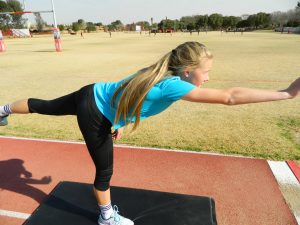
Balansoefeninge word in twee groepe verdeel, nl. statiese (stabilisering) en dinamiese beweging. ‘n Voorbeeld van statiese balansbeweging is as die atleet die “birddog” staande (op ‘n gelyk vloer) doen.

F10

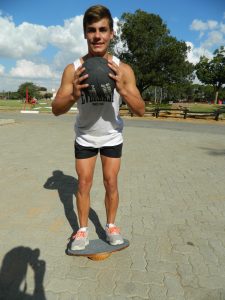
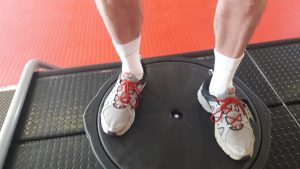
As die atleet egter dieselfde oefening op ‘n “wobble board”/BOSU-bal doen, is die balansoefening dinamies. [Die BOSU-bal kan aan albei kante gebruik word]

DSCN8675            20180228_081530

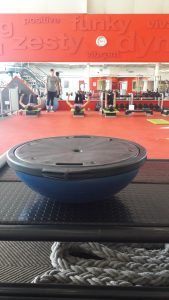
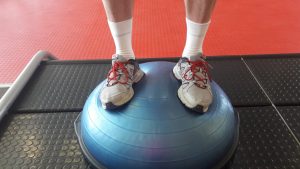
          Wobble-bord                                       BOSU-bal

20180228_085608         20180228_085645

         BOSU-bal, platkant onder                             BOSU-bal, rondekant onder

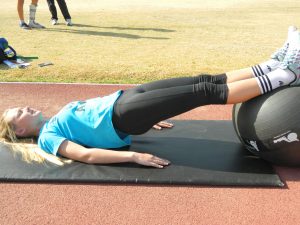
Die gebruik van die Swiss-oefenbal lewer ook goeie resultate

F1            F9

Wanneer die BOSU-bal/”wobble board”/ oefenbal in enige oefening gebruik word, prikkel dit die heeltyd die sentrale senustelsel om regstellings te maak sodat die liggaam in balans/ewewig bly. Dit, op sy beurt, versterk die atleet se kernspiere in sy middellyf – die sogenaamde “core”! Tydens hierdie oefeninge word alle bindweefsel geaktiveer en alle spiere – klein en groot – word ingespan.

Goeie oefeninge is hurke/”squat”s, skoueroefeninge, eenbeenoefeninge, almal staande op die BOSU-bal (of “wobble board”) of sittend op die Swiss-oefenbal en met of sonder handgewigte. [Sorg net vir ondersteuning, sodat AS die atleet sy balans verloor hy/sy nie val en seerkry nie!] Dieselfde oefeninge kan ook staties gedoen word, deur met die voete op “vaste “ grond te staan – laasgenoemde is miskien minder effektief, maar speel wel ‘n rol in die versterking van die liggaam se kernspiere en die bindweefsel tussen die verskillende spiere.

Hoe beter die atleet sy/haar liggaam in balans kan hou, hoe minder moeite ervaar die atleet om vloeiende bewegings uit te voer. Hoe sterker die bindweefsel tussen die spiere is, hoe meer effektief kan die enkels, voete en bene ‘n bydrae tot die atleet se prestasie lewer.

‘n Interessante eksperiment wat gedoen kan word, is om die oë te blinddoek terwyl balansoefening gedoen word. ‘n Mens se oë en natuurlik ore is belangrike kontroles om balans te verseker…probeer hulle ook oefen deur innoverend oor die saak te dink.

Gevolgtrekking

Dit is alreeds bewys dat as afrigters balansoefeninge in hul programme insluit, hul atlete se prestasie sal verbeter.

Bron:  Wikipedia vir definisie van Propriocepsie

Youtube


Talentidentifikasie in skole


Deur Rudolph Cloete, ASA Vlak III en VSAAV Vlak III 

Talent ID het eintlik twee bene, nl. identifisering van nuwe talent en, tweedens, die identifikasie van wat ‘n gevestigde atleet se beste item gaan wees!

Die eerste identifikasie, nl. identifisering van nuwe talent vind primêr in die primêre skool plaas. Wanneer ‘n laerskoolleerder die regte ouderdom bereik, sal die skool “kyk” of hy of sy in ‘n spesifieke item die mas sal opkom. Baie talent gaan egter verlore wanneer atlete al as O/8’s in naellope mag deelneem, maar later eers as 0/10’s aan o.a Verspring of Duskusgooi mag deelneem. Baie keer is die atleetjie klaar gevestig in die naellope en wil nie oorskakel nie. Die gesoute Atletiekhoof by die skool sal dit in gedagte moet hou dat die atleetjie wat in die naellope uitgeval het, miskien oor 2 jaar die uitstaande verspringer kan word.

‘n Goeie idee is om alle O/8’s aan al die “atletiekitems” bloot te stel – al kan hulle nog nie aan sekeres deelneem nie: tennisbalgooi is ‘n goeie manier om sien of ‘n atleetjie ‘n “arm” het, staande verspring sal ‘n goeie aanduiding gee van ‘n atleet se horisontale veerkrag – klap teen ‘n muur sorg as toets vir vertikale veerkrag! So kan inoverende “toetse” uitgedink word om talent te indentifiseer.

In sommige oorsese lande word veelkampbyeenkomstes gereël om jong talent te identifiseer.

Die hoërskoolafrigter moet ook in ag neem dat kinders wat in die primêre skool uitgeval het, nie noodwendig vir ewig uit atletiek is nie: kinders ontwikkel deurlopend en goeie atlete is al op ‘n Gr.8-kleurebyeenkoms “ontdek” of op die stoepe raak gesien!

Die tweede identifikasie, nl. identifisering van watter item die beste sal wees, is ‘n meer ingewikkelde proses! Hierdie identifisering gebeur meer op hoërskoolvlak, waar die Atletiekhoof ‘n kardinale rol speel.

Die Atletiekhoof is o.a verantwoordelik dat die skool se atletiekspan kompeterend is! Kom ek gee u ‘n voorbeeld van wat ek bedoel: As ‘n O/15 seun die 100m in 12.00sek hardloop, help dit nie om hom in te skryf vir die 100m op die Interhoërbyeenkoms nie! Die feit dat hy die skoolkampioen is, is geen rede om hom daar in te skryf nie! Hy gaan nêrens kom nie en die naelloopafrigter gaan nie uit sy eie hierdie seun wegstuur na ‘n ander item nie!

Dit is waar die Atletiekhoof inkom – hy moet nou ‘n ingeligte besluit tot voordeel van die atleet neem! (en sodoende ook die skool bevoordeel) Hy kan ‘n prestasietabel raadpleeg of uitvind wat die provinsiale kwalifiserende tyd vir die 100m is of na die 100m tye op vorige Interhoërbyeenkomstes kyk! ‘n 12.00sek mag nie genoeg spoed vir die 100m wees nie, maar dit mag in die 400m of 800m meer as genoeg vir ‘n wen wees! Verspring kan ook goeie ‘n opsie wees!

Hierdie identifisering moet so vroeg moontlik in die jaar gedoen word – en ook so vroeg moontlik in die atleet se hoërskoolloopbaan plaasvind! ‘n Mens moet in ag neem dat die nuwe item nuwe uitdagings, bv. die aanleer van nuwe tegnieke, aan die atleet kan stel wat tyd gaan neem om onder die knie te kry.

Die Atletiekhoof moet hom ook nie blind staar teen ‘n Gr8-leerder se laerskool= items nie …kinders ontwikkel en groei teen verskillende tempo’s! Dis veral seuns, wat groter as hul maats is, wat in die primêre skool presteer…maar in Gr 10 is hulle nie meer die grootste in die klas nie! Daar is ‘n paar nuwe items – Driesprong, Hamergooi, hindernis, ens – wat eerder oorweeg kan word.

Die meeste top-atletiekskole maak van bogenoemde sisteem gebruik om sodoende die beste van hul beskikbare talent gebruik te maak. Kinders wil presteer – en as dit nie gebeur nie, hou hulle op met deelneem. Op hul eie sal atlete nie sommer na ‘n ander ietm verander nie – en as hulle dit wel doen, is dit gewoonlik ‘n oningeligte besluit! Die Atletiekhoof, met al sy/haar atletiekkennis, is die ideale persoon om die regte item aan te beveel!